.svg)
.svg)

AI-Ready Website Optimization
How to prepare your website for AI tools, search, and automation — including the five AI-readiness dimensions, the 56% failure rate, crawler access, JSON-LD schema, entity signals, and a practical 20-day improvement roadmap.
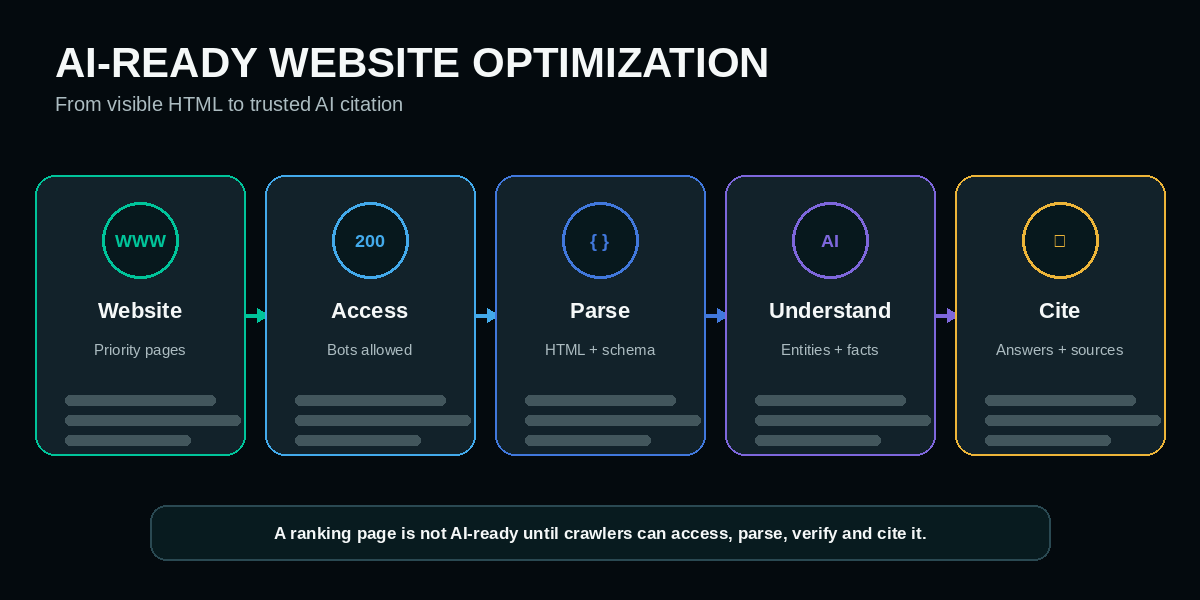
A website can rank first in Google and still be invisible to ChatGPT, Perplexity, Claude, or other AI tools. AI-ready website optimization closes the gap between traditional search visibility and machine readability by improving access, structure, entity clarity, and trust.
Crawler access is the prerequisite. Schema, entity signals, and excellent content cannot help if AI systems cannot reach or read the page.
What Is the State of AI Website Readiness in 2026?
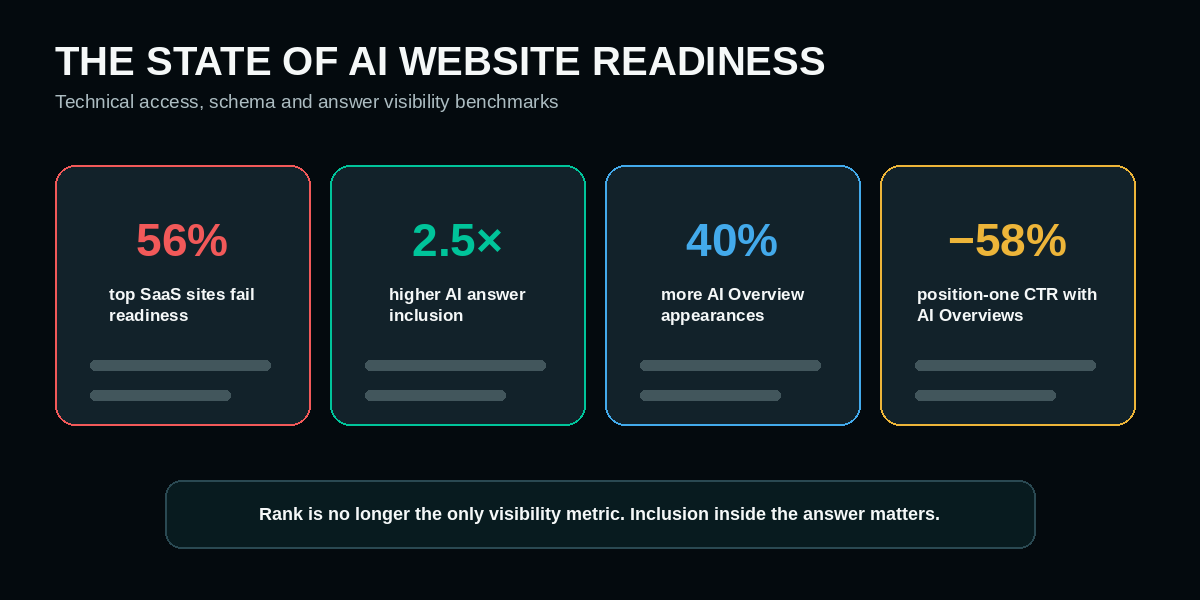
Yaniv Goldenberg’s 2026 AI Search Readiness benchmark reported that 56% of the top SaaS sites tested failed the assessment across technical access, schema, entity signals, on-page clarity, and E-E-A-T. Stackmatix reported a 2.5× higher chance of inclusion in AI-generated answers when structured data was implemented correctly, while Ahrefs reported a 58% reduction in position-one organic click-through rate when AI Overviews appeared.
What Does “AI-Ready” Actually Mean for a Website?
Direct answer: An AI-ready website is one that AI crawlers can access, parse, and understand without barriers, and that presents information clearly enough for AI systems to extract facts, verify relationships, identify the business, and decide whether the source is trustworthy enough to cite.
Traditional technical SEO remains the foundation. Google’s current generative AI optimisation guidance states that foundational SEO practices continue to apply. AI readiness adds intentional structure around visible HTML, answer blocks, schema, entity consistency, and verifiable authorship.
For the foundational explanation, read What Is an AI-Ready Website?. Related technical perspectives include iPullRank’s AI Search framework, Semrush’s technical SEO guide, Ahrefs’ technical SEO guide, and Neil Patel’s technical SEO overview.
What Are the Five AI Readiness Dimensions?
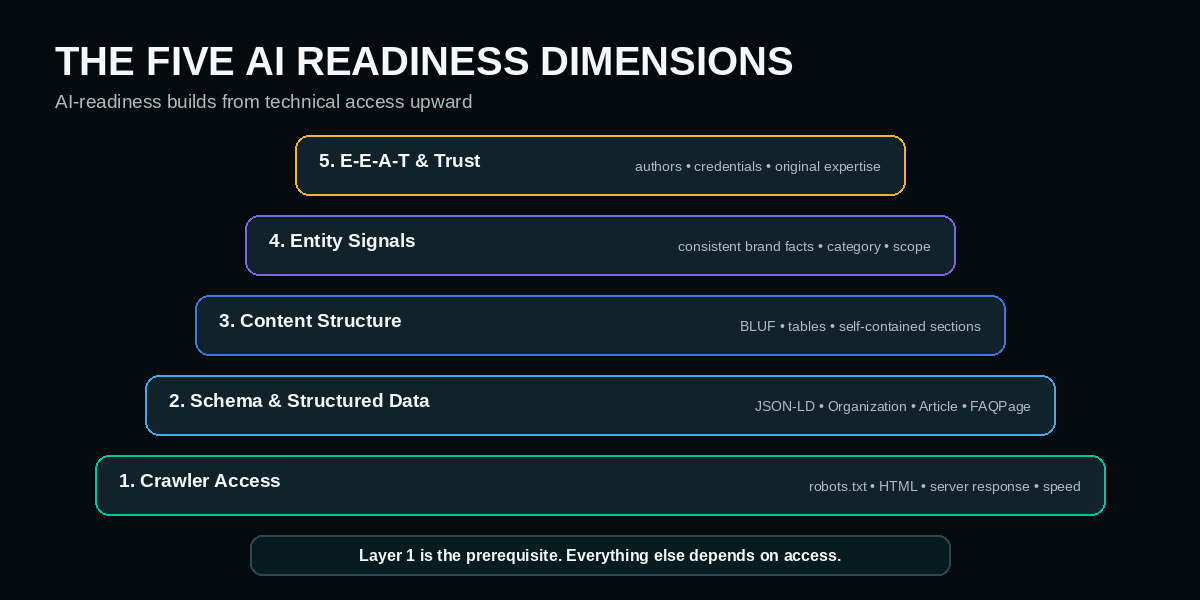
| Readiness Dimension | What It Enables | Priority |
|---|---|---|
| 1. Crawler access | Relevant crawlers can reach the page and access the complete rendered content. Google documents how JavaScript content is rendered for Search. | Foundation — fix first because every other layer depends on access. |
| 2. Schema and structured data | AI systems can identify entity type, authorship, freshness, Q&A structure, services, and relationships without guessing. | High — structured confirmation improves classification and extraction. |
| 3. Content structure | AI can extract self-contained answer blocks, comparison rows, process steps, and named facts. | High — retrieved content still needs clean citation units. |
| 4. Entity signals | The brand, category, audience, location, and key claims can be identified consistently across sources. | Medium–High — consistency reduces misclassification and hallucination. |
| 5. E-E-A-T and trust | AI systems can verify who created the content and why the source deserves confidence. | Medium — compounds every other readiness layer. |
A dedicated structural workflow is available in How to Structure a Website for AI Understanding.
Which Technical Failures Make a Website Invisible to AI?
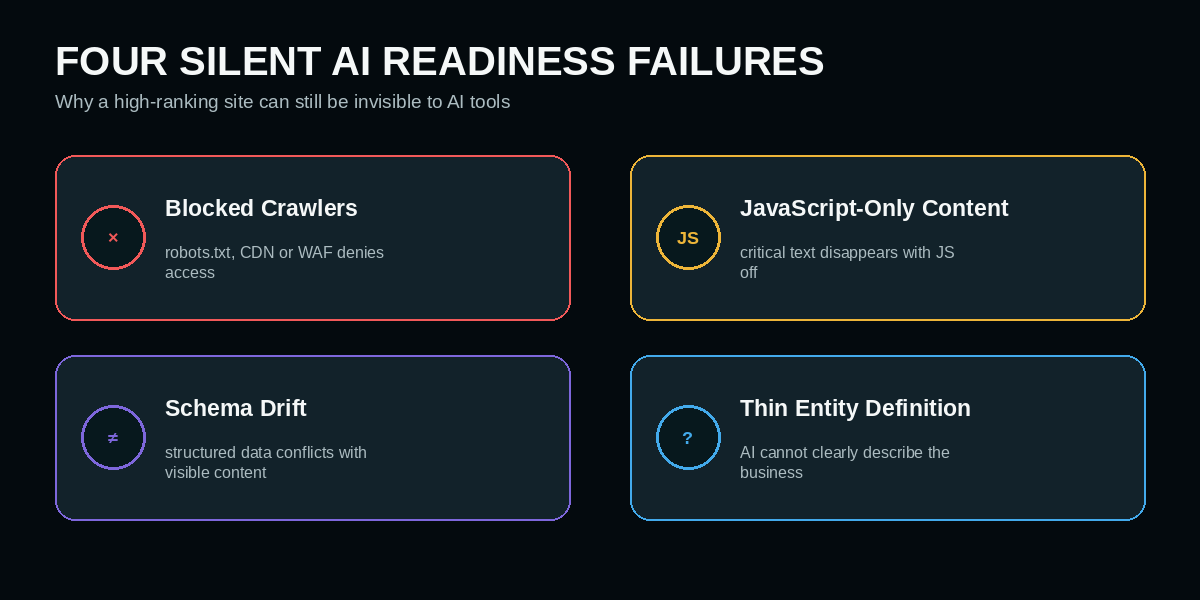
AI crawlers are blocked
Over-broad robots.txt rules, CDN bot protection, firewall settings, or training-data restrictions can also block live-retrieval crawlers. Check each documented crawler separately. OpenAI distinguishes OAI-SearchBot, ChatGPT-User, and GPTBot, while Perplexity documents PerplexityBot and Perplexity-User.
Critical content requires JavaScript
If H1s, H2s, service descriptions, prices, or evidence are absent from the rendered page delivered to a crawler, retrieval systems may receive an incomplete version. Move priority content into server-rendered or statically generated HTML.
Schema contradicts the visible page
Schema drift occurs when structured prices, dates, titles, availability, or authorship no longer match what users see. Conflicting signals weaken validation trust and can invalidate the markup.
The business entity is too thin
Generic statements such as “we help companies grow with AI” do not define category, audience, geography, differentiator, or proof. Homepage, About, and service pages must state those facts explicitly.
Read Why Your Website Isn’t AI-Ready: Common Mistakes to Avoid.
Which Schema Types Matter Most for AI Visibility?
Direct answer: Organization, Person, Article or BlogPosting, FAQPage, HowTo, Service or Product, and BreadcrumbList can clarify page meaning when they match visible content. Google’s structured-data guidance explains that markup must accurately represent the page. Implement them in JSON-LD and ensure every structured field matches the visible page exactly.
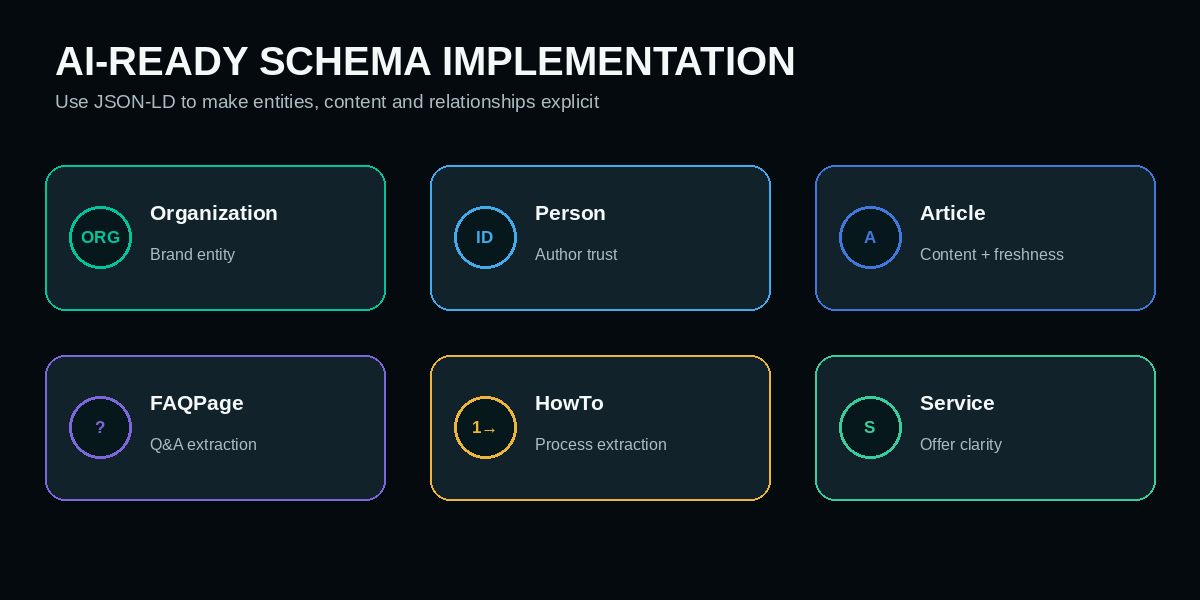
| Schema Type | What It Tells AI | Priority | Where to Implement |
|---|---|---|---|
| Organization | Legal name, description, logo, contact point, founding details, area served, and sameAs identities. | Critical — establishes the brand entity. | Homepage, About page, and site-wide footer layer. |
| Person | Named author, job title, credentials, LinkedIn identity, and organisational affiliation. | Critical — supports author trust and E-E-A-T. | Every author biography and key team profile. |
| Article / BlogPosting | Headline, author, publisher, description, datePublished, and dateModified. | High — confirms page type and freshness. | All editorial and resource content. |
| FAQPage | Visible questions and accepted answers as explicit Q&A pairs. | High — supports direct-answer extraction. | Genuine FAQ sections and support content. |
| HowTo | A named sequence of actionable process steps. | High — aligns with list-format “how to” retrieval. | Implementation guides, tutorials, and process pages. |
| Service / Product | Offer name, description, provider, audience, area served, and commercial details. | High — reduces guesswork about what the business sells. | Every service and product page. |
| BreadcrumbList | The page’s hierarchical position and topical relationship to pillar and cluster content. | Medium — supports semantic site architecture. | Pillar, cluster, category, service, and product pages. |
Structured data does not replace visible clarity. It confirms meaning, relationships, and freshness so AI systems do not have to infer them.
AI-ready schema implementation principleHow Do You Audit AI Crawler Access?
Crawler access is a four-part audit covering robots.txt, visible server-rendered HTML, CDN or WAF responses, and page performance. Resolve access failures before investing in schema or content restructuring.
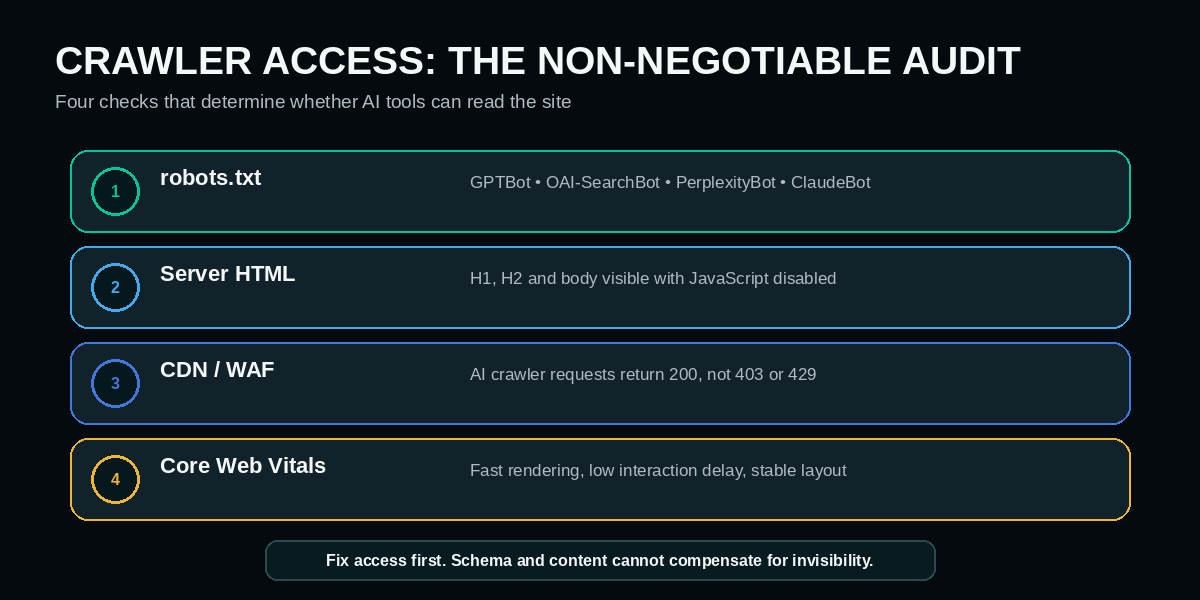
| Access Check | How to Verify | Fix if Failing |
|---|---|---|
| robots.txt allows AI crawlers | Search for GPTBot, OAI-SearchBot, PerplexityBot, ClaudeBot, and Googlebot-Extended. Confirm intended content paths receive Allow rules. | Add explicit directives. Separate training crawlers from live-search crawlers where policy requires different access. |
| Server-rendered HTML | Disable JavaScript and confirm H1, H2, body content, service information, and evidence remain visible. | Move critical content to SSR, static generation, or server-delivered HTML. |
| No CDN or WAF blocking | Review server logs and confirm priority-page requests return 200 rather than 403, 429, challenge, or timeout responses. | Adjust bot-management rules and allow verified crawler traffic. |
| Performance and Core Web Vitals | Check priority pages for fast loading, responsive interaction, and layout stability using Core Web Vitals. | Compress media, cache assets, reduce render-blocking code, and lazy-load non-critical content. |
For a deeper technical layer, read Technical Website Optimization for AI Tools.
Should You Implement an llms.txt File?
Direct answer: llms.txt is an emerging, forward-looking convention for presenting an LLM-readable summary of a website. It is not a confirmed ranking factor and should not replace robots.txt, sitemaps, schema, or visible HTML, but it can document site purpose, priority resources, and preferred interpretation in a machine-friendly format.
Treat llms.txt as an experimental accessibility layer, not as a shortcut to AI visibility. Core access, content, schema, and entity problems must still be fixed first.
How Should Website Content Be Structured for AI Understanding?
An AI-ready page uses question-led headings, BLUF openings, self-contained sections, specific tables, named-source statistics, visible dates, and explicit entities. Every section should work as a complete answer block when extracted from the rest of the page.
| Content Element | Why AI Needs It | Implementation Standard |
|---|---|---|
| BLUF opening | AI systems can identify the answer immediately and extract a bounded passage. | Open every important H2 with a direct 40–60 word answer. |
| Named-source statistics | Specific, attributable facts provide high-confidence citation units. | Include figure, named source, year, and measurement context in one sentence. |
| Comparison tables | Rows and columns create dense, independently citable facts. | Use exact values and factual descriptors rather than “better” or “advanced.” |
| Named author and credentials | Verifiable authorship supports source credibility and accountability. | Show name, title, specialisation, LinkedIn, author page, and Person schema. |
| Visible publish and update dates | Freshness affects trust and eligibility for time-sensitive answers. | Keep the visible date and Article dateModified aligned after substantive edits. |
Reusable layouts are covered in AI-Friendly Website Content Blocks.
How Do Entity Signals and E-E-A-T Strengthen AI Visibility?
Direct answer: Entity signals help AI systems identify the business consistently, while E-E-A-T helps them judge whether the business and author are credible enough to cite. Both depend on explicit, verifiable, and consistent facts rather than promotional wording.
AI-Ready Website Audit Checklist
| # | Dimension | What to Check | Pass Condition |
|---|---|---|---|
| 1 | Crawler access | GPTBot, OAI-SearchBot, PerplexityBot, and ClaudeBot are reviewed in robots.txt. | Intended content paths are accessible to the relevant crawlers. |
| 2 | Crawler access | Priority-page H1s, H2s, and body content remain visible with JavaScript disabled. | Critical content is present in server-delivered HTML. |
| 3 | Crawler access | Server logs show successful crawler responses on priority pages. | No CDN, firewall, challenge, or rate-limit block prevents retrieval. |
| 4 | Performance | Priority pages pass Core Web Vitals and render quickly. | Performance tools report healthy loading, interaction, and layout stability. |
| 5 | Schema | Organization schema includes name, description, URL, logo, contact data, and sameAs. | The block validates without errors and matches visible information. |
| 6 | Schema | Every named author has Person schema, role, LinkedIn sameAs, and organisational affiliation. | Every important content page shows accountable authorship. |
| 7 | Schema | Editorial pages contain Article schema with author, publisher, datePublished, and dateModified. | Freshness fields update after substantive changes and validate correctly. |
| 8 | Schema | FAQPage and HowTo markup appear only where corresponding content is visible. | Structured data and the page content match exactly. |
| 9 | Schema drift | Prices, dates, titles, availability, names, and descriptions match between markup and page. | Quarterly spot checks show no contradictions. |
| 10 | Content | Every important H2 opens with a direct answer. | The first 40–60 words answer the heading completely. |
| 11 | Content | Key sections contain one specific named-source statistic or evidence point. | No vague “research shows” claims remain on priority pages. |
| 12 | Entity | Brand name, category, founding facts, headquarters, and description match across external profiles. | Spot checks show consistent entity facts. |
| 13 | Entity | Homepage and About page state category, audience, geography, differentiator, and proof. | A first-time human or AI can describe the business accurately. |
| 14 | Forward-looking | A useful llms.txt summary exists at the domain root. | The file loads and accurately describes priority site resources. |
What Is the Three-Step AI Readiness Improvement Process?
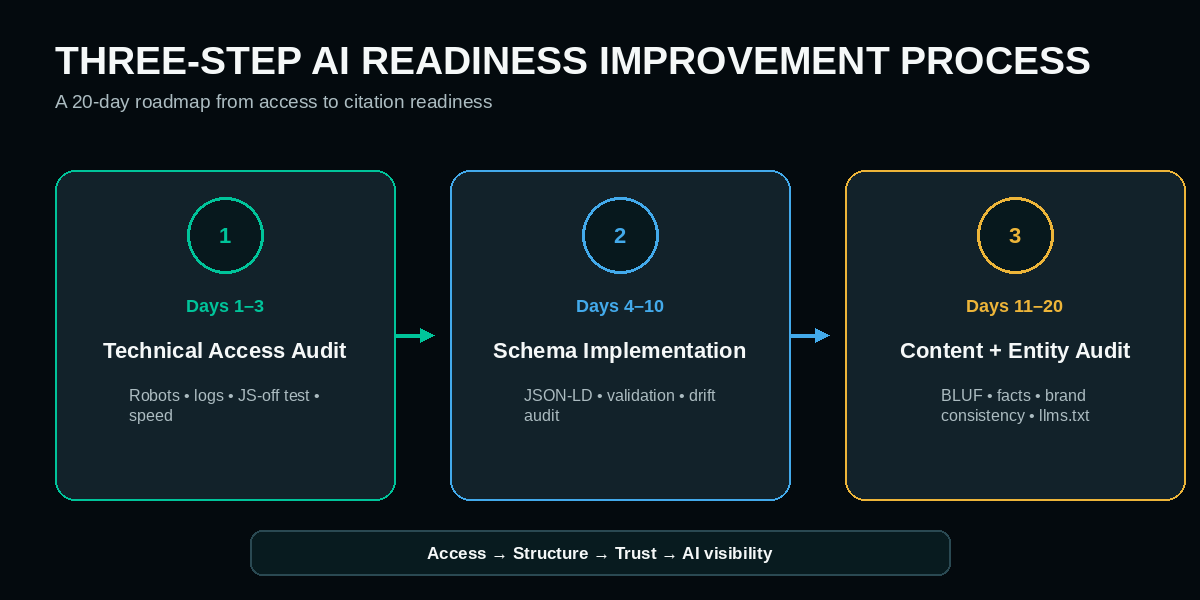
Days 1–3: Technical access audit
Review robots.txt, server logs, JavaScript-disabled rendering, priority-page responses, CDN rules, and performance. Fix access barriers before any other investment.
Days 4–10: Schema implementation and audit
Deploy Organization, Person, Article, FAQPage, HowTo, Service, and BreadcrumbList markup where relevant. Validate every block and audit for drift against visible content.
Days 11–20: Content and entity audit
Rewrite key pages to define category, audience, geography, and differentiator. Apply BLUF, add named evidence, align external entity facts, and publish a useful llms.txt summary.
How Should AI Website Readiness Be Measured?
| Metric | How to Measure | What Improvement Looks Like |
|---|---|---|
| AI crawler access rate | Review priority-page server responses for each relevant AI crawler. | Successful 200 responses increase and blocked or incomplete retrieval declines. |
| Visible HTML coverage | Compare priority content with JavaScript enabled and disabled. | All critical headings, facts, services, and proof remain present without client rendering. |
| Schema validation and drift | Validate structured data and compare important fields against visible content quarterly. | Errors and contradictions decline to zero on priority pages. |
| Entity consistency score | Spot-check brand name, category, founding year, headquarters, description, and sameAs profiles. | The same core entity facts appear consistently across owned and recognised external sources. |
| AI answer inclusion | Run a fixed set of buyer questions across ChatGPT, Perplexity, Google AI, Gemini, and Copilot. | The brand and its pages appear more often and are described more accurately. |
Frequently Asked Questions
What makes a website AI-ready?
Can a site rank on Google but be invisible to ChatGPT?
Which schema types matter most for AI visibility?
What is llms.txt and should I implement it?
Why does JavaScript rendering create an AI-readiness risk?
What should be fixed first during an AI-readiness audit?
Key Takeaways
- A page can rank in Google and still be invisible or illegible to AI retrieval systems.
- Crawler access is the non-negotiable foundation of AI readiness.
- Critical content should exist in visible server-rendered HTML.
- JSON-LD schema confirms entities, authorship, content type, freshness, services, questions, and processes.
- Schema drift weakens validation trust and should be audited quarterly.
- BLUF openings, named evidence, specific tables, and self-contained sections improve extraction.
- Consistent entity facts and verifiable author proof improve citation confidence.
- llms.txt is a useful forward-looking layer, but not a substitute for technical and content fundamentals.

About the Author
Marcus Hibbert is the founder of AI Recommended, a leading Generative Engine Optimisation (GEO) agency helping UK B2B technology companies become the trusted recommendation across ChatGPT, Google AI Mode, AI Overviews, Gemini, Claude, Perplexity and Microsoft Copilot whenever decision-makers search for products, services and solutions.
Connect with Marcus on LinkedIn.
Request an AI Optimisation Audit
Discover how AI platforms describe, cite and recommend your brand across the prompts your ideal buyers use—and uncover opportunities to become AI's trusted recommendation.
By submitting this form, you’re requesting an Artificial Intelligence Optimisation (AI Optimisation) audit for your brand.

.png)