custom white shadow vectorcustom white shadow vector
AI Search & GEO

What Is Generative Engine Optimization (GEO)? 5 Ways It Changes How You Get Found Online

Google rankings still matter — but they're no longer enough. Here's what GEO is, why it differs from SEO, and how to start optimising for the AI tools your customers are already using.

✍ Marcus Hibbert📅 Updated June 2026⏱ 18 min read🏙 London, UK

The vast majority of businesses have yet to recognize that the core pathways through which users encounter brands have undergone a complete transformation.

The early customer acquisition strategy relying on Google Search Engine Optimization (SEO) still works, but it has long ceased to cover the full scope of modern customer acquisition logic.

Today, the search behavior of potential users has evolved entirely: they ask ChatGPT about their needs, use Perplexity to compare solutions, check the AI summaries at the top of Google’s organic search results, and almost no one browses through the traditional set of ten blue search links one by one anymore.

The integrated answers generated by generative AI will cite specific brands, tools, and information sources. Cited brands gain incremental business, while unmentioned brands become completely invisible to buyers.

This trend has spawned the entirely new field of Generative Engine Optimization (GEO), which is by no means a simple re-packaging of SEO. It is a brand-new discipline with distinct signals, success metrics, and logic for building content credibility.

This guide covers all core GEO content in accessible language, and provides actionable plans that can be implemented as early as this week for all types of entities, including London-based consulting firms, retail brands, and B2B enterprises.

73%
of B2B buyers now use AI tools as part of purchase research
5.1×
higher conversion rate from AI-referred traffic
38%
overlap between Google's top 10 and AI citation sources

Sources: McKinsey & Company 2025 · Ahrefs AI Overviews Study 2025 · Averi 680M Citation Analysis 2026

What Is Generative Engine Optimization (GEO)?

Generative Engine Optimization, or GEO, is a method that optimizes a brand, its content, and its digital online presence to raise the probability of the brand being cited or recommended across the five mainstream AI search tools: ChatGPT, Perplexity, Google's AI Overviews, Microsoft Copilot, and Gemini.

This term originated from a landmark 2024 study published by Princeton University and IIT Delhi in ACM SIGKDD. The study built the first systematic framework for generative engine content retrieval and ranking, and verified that compliant GEO strategies can boost a brand's AI exposure by up to 40%.

GEO differs fundamentally from traditional Search Engine Optimization (SEO) in three core dimensions: output form, ranking signals, and underlying strategy.

“Generative Engines typically satisfy queries by synthesising information from multiple sources and summarising them using LLMs… content creators have little to no control over when and how their content is displayed.”

— Aggarwal et al., Princeton University / IIT Delhi, ACM SIGKDD 2024

In the widely recognized scenario of traditional search engines, the core role of SEO is to optimize a website’s authority, secure a higher search ranking, and gain exposure from organic traffic.

The logic of GEO in the generative AI search scenario is completely different. Measured by the metric of exposure visibility, small and medium-sized merchants that have not implemented GEO will directly lose their eligibility to be recommended in AI search.

The core function of GEO is an optimization solution that helps all types of entities secure effective exposure within the AI search ecosystem.

🔍 Google Insight
AI Overviews are designed to help people quickly understand a topic and find the most relevant information. The best way to appear in AI Overviews is to create helpful, reliable, people-first content.
LR
Liz Reid
VP, Search — Google
📹 Recommended Watch
Google's AI Overviews Explained — What You Need to Know
Google Search Central · YouTube
Google’s team walks through how AI Overviews work, what content gets cited, and how retrieval selects sources.

Why GEO Matters Right Now

Many people view Generative Engine Optimization (GEO) as a future issue that only requires attention after AI search matures. While this intuition seems reasonable, it is actually causing businesses to suffer real, immediate losses in their current exposure.

In March 2026, Averi analyzed 680 million AI citations and found that 73% of B2B buyers have integrated AI tools such as ChatGPT and Perplexity into their procurement research.

In August 2025, McKinsey surveyed nearly 2,000 U.S. consumers, and found that 50% of respondents—including a majority of Baby Boomers—use AI to search for and purchase goods.

The GEO market was valued at $848 million in 2025, and is projected to reach $33.7 billion by 2034, with a compound annual growth rate of 50.5%.

💡 Why AI-referred traffic converts better

AI search traffic converts at 14.2% compared to Google organic's 2.8% — a 5.1× advantage. Buyers arriving through AI recommendations are often informed, pre-qualified, and closer to a purchasing decision.

Third-party SEO tool provider Ahrefs conducted a 6-month tracking study, in which it analyzed 863,000 keywords and 4 million AI Overview URLs.

The research found that the overlap between Google Search’s top 10 results and the sources cited by Google’s search AI dropped from 76% to 38%; two-thirds of these AI-cited sources did not rank on the first page of search results, and the protective value of enterprises’ SEO investments is far lower than expected.

🔵 Microsoft Bing Insight
Generative search doesn't just replace links; it synthesizes the most credible, structured answers from across the web. Brands investing in clear, well-attributed content today are building an authority moat that compounds as AI search grows.
MP
Mikhail Parakhin
Former CEO, Advertising & Web Services — Microsoft

GEO vs. Traditional SEO: What's Actually Different

Traditional SEO and GEO both aim for brand visibility, but traditional SEO focuses on webpage rankings while GEO targets direct inclusion in AI-generated answers.

Traditional SEO competes for list rankings where even 6th place gains exposure. GEO is an all-or-nothing game: if your content isn't selected for the generative answer, you lose all exposure entirely.

DimensionTraditional SEOGenerative Engine Optimization
Primary goalRank in search resultsGet cited in AI-generated answers
Key signalsBacklinks, keywords, page speedEntity clarity, named authorship, depth
Success metricRankings, clicks, impressionsCitation frequency, AI share of voice
Content formatKeyword-optimised pagesStructured, fact-dense, definitional
Competition10 results per page1–3 recommendations per AI response
Traffic modelClick-drivenInfluence-driven
Trust signalsPageRank, domain authorityAuthor credentials, cited sources, E-E-A-T
🔍 Google Search Insight
Create content for users, not search engines. That principle is even more true in the era of AI-generated answers.
GI
Gary Illyes
Analyst, Search Relations — Google

How Generative Engines Actually Retrieve and Rank Sources

Effective AI optimization requires mastering the exact retrieval and synthesis logic governing generative search citations, not relying on surface-level tactics.

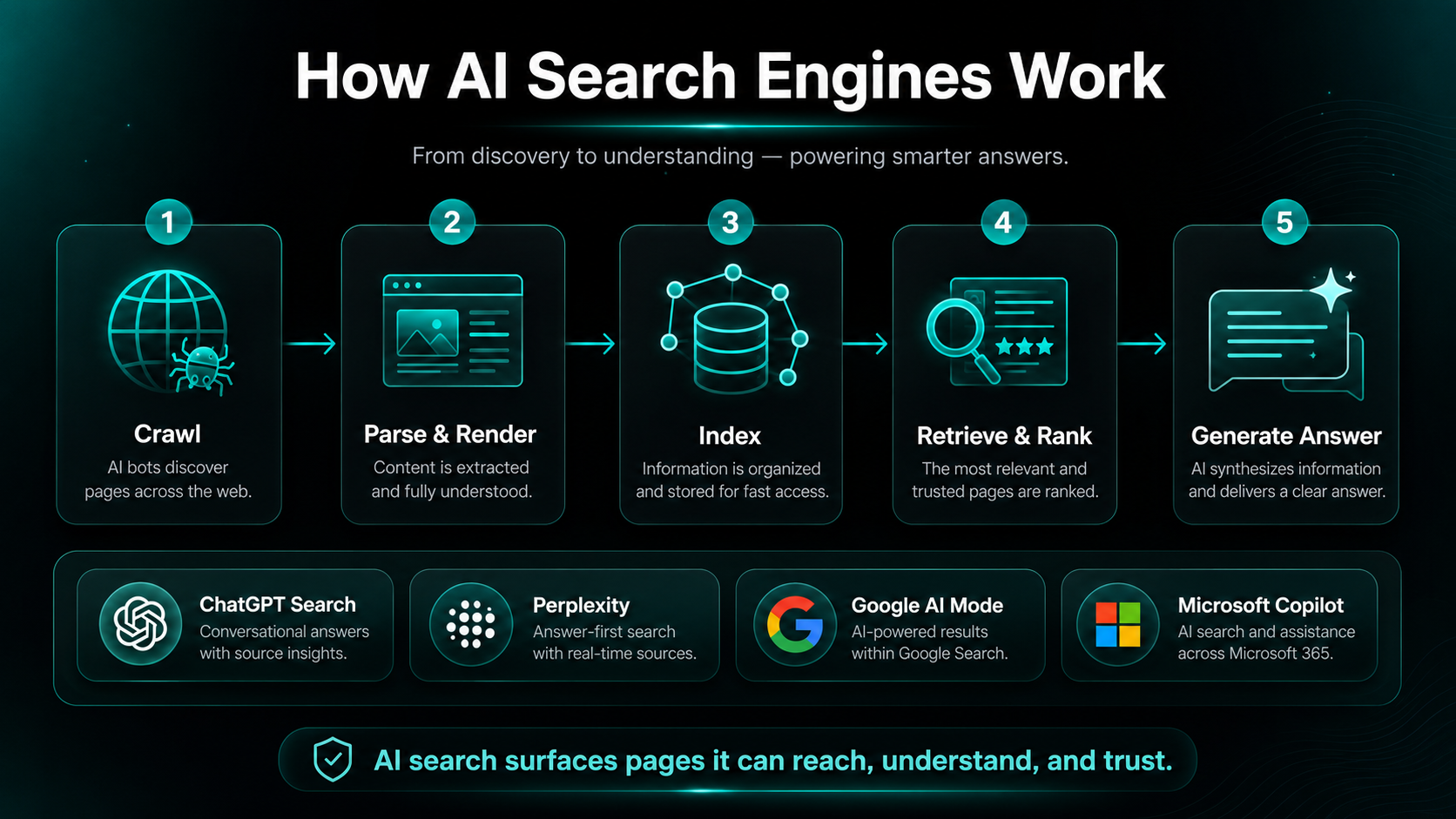
Traditional search returns links; generative search uses a four-stage end-to-end workflow to determine which brand content gets cited.

The four stages of AI search

  1. Query divergence: the original query is expanded into multi-dimensional sub-queries covering pricing, usability, compatibility, reviews, and other dimensions.
  2. Retrieval: candidate documents are pulled from web indexes and vector databases; sources with clear structure and focused themes are selected more stably.
  3. Scoring and filtering: content is rated against relevance, recency, credibility, and structural quality. Clear authorship and cited data earn higher scores.
  4. Synthesis and citation: the highest-scoring content is integrated to generate the final response.
🤖 OpenAI Insight
Search is shifting from links to direct answers. The sources that get cited are those with genuine, unmistakable authority on specific topics.
SA
Sam Altman
CEO — OpenAI

A joint Princeton-IIT Delhi GEO study empirically proved that content optimization strategies drastically increase visibility across seven major generative search engines.

Hard data shows that adding source statistical data boosts AI citation rates by up to 40% and compliant authorship drastically raises authority scores, while traditional backlinks show no measurable impact.

📹 Recommended Watch
How RAG Works — Explained Simply
IBM Technology · YouTube
A simple explanation of Retrieval-Augmented Generation and how it supports AI search experiences.

5 Ways GEO Changes Your Content and Marketing Strategy

1. You're writing for synthesis, not for clicks

GEO marketing proposes that in the current AI search era, the value of entity authority far outpaces that of domain authority in the traditional SEO system.

Domain authority barely influences AI citations; entity authority—a brand's clear identity, scope, and team expertise—is what AI prioritizes.

2. Entity authority matters more than domain authority

Core off-site assets like Google Business Profile, bylined author pages, LinkedIn company pages, and industry press mentions accumulate AI-facing authority and easily plug into day-to-day operations.

🔎 Perplexity AI Insight
We want to surface sources that have genuine expertise — people and organisations that clearly know what they're talking about.
AS
Aravind Srinivas
CEO — Perplexity AI

3. Structured content wins over long-form volume

Mainstream AI systems prioritize structured clarity over raw length. A concise, highly structured article allows an AI model to parse entities and extract facts far more efficiently than an unstructured, 7,000-word piece.

Bylined, 1,400-word articles with clear headings, hard data, and precise definitions win more AI citations than rambling, unstructured long pieces.

4. Reviews, third-party mentions, and off-site signals carry new weight

Ensure every section can be cited independently; off-site signals like third-party evaluations carry immense weight in AI assessments.

Off-site signals like G2 reviews, Trustpilot ratings, and Reddit posts drive AI citations far better than just a polished corporate website.

5. Speed to authority beats speed to publish

Authority building speed beats publishing speed. A high-quality, in-depth article from six months ago outperforms a low-quality, thin summary from yesterday.

📹 Recommended Watch
GEO: Generative Engine Optimization — Whiteboard Friday
Moz · YouTube
A practical breakdown of how GEO differs from SEO and how content should be structured for AI citation.

The Core GEO Ranking Factors

1. Authoritative sourcing and cited statistics

AI prioritizes credible, clearly attributed data. Pairing government, academic, or industry research with standardized attribution and valid links is the highest-impact GEO strategy.

Vague expressions must not be used.

2. Named expert authorship

Real-name authors with verifiable qualifications receive far more citations than anonymous content.

Author homepages and LinkedIn links prove professional capabilities to both humans and machines.

3. Definitional clarity and semantic structure

Tailor content to AI extraction via clear definitions, straightforward openings, explicit terms, and question-aligned titles.

4. Structured data and schema markup

Structured data schema such as Article, FAQ, HowTo, and Organization gives AI machine-readable data, aiding entity recognition and attribution.

5. Topical authority and content depth

Topical authority and depth drive AI screening. Comprehensive content clusters far outperform isolated pages.

6. Content freshness and factual accuracy

Content freshness and accuracy drive AI citations. Regular audits and updates prevent outdated stats from reducing GEO performance.

📊 Industry Expert Insight
AI search winners aren't the biggest or most linked-to; they are brands with genuine, demonstrable topic expertise.
RF
Rand Fishkin
Co-founder, SparkToro

GEO Best Practices Checklist

Use this checklist when creating or auditing any piece of content for AI citation readiness:

  • Clear, citable definition of the topic in the opening section
  • All statistics include a named, verifiable source with a working hyperlink
  • Named author with a linked profile page and visible professional credentials
  • Headings structured as questions or direct topic statements
  • Schema markup implemented: Article, FAQPage, HowTo, or Organization
  • Content covers the topic with sufficient depth to answer multiple sub-questions
  • Internal links to related cluster articles and sub-articles
  • External links to high-authority, relevant third-party sources
  • Brand entity information consistent across Google Business Profile, LinkedIn, and website
  • Content reviewed and updated within the last six months
  • G2, Trustpilot, or relevant industry review profiles active and current
  • At least one attributed quote from a named industry expert per major section

Common GEO Mistakes Businesses Make

Treating GEO as "SEO with AI keywords"

Adding "AI-powered" to meta descriptions isn't GEO. GEO requires structural and authority signals, not subject matter.

Ignoring off-site signals

GEO expands beyond your website; AI tools synthesize data from review platforms, directories, and forums.

Publishing without named authorship

Anonymous content loses AI citations. Adding authorship is the fastest, lowest-cost GEO fix today.

Measuring GEO with SEO tools

SEO tools don't track GEO properly. Track AI visibility via regular prompts across ChatGPT, Perplexity, and Gemini.

📊 SEO Industry Insight
The mistake most SEOs make with GEO is assuming it's a technical fix rather than a strategic shift.
AL
Aleyda Solis
International SEO Consultant

How to Get Started: A Practical 90-Day Plan

Days 1–30: Foundation

  • Audit your content against the GEO checklist
  • Set up named author pages with credentials and LinkedIn links
  • Make GBP, LinkedIn, and website About information consistent
  • Implement Article and Organization schema
  • Run a baseline AI visibility audit

Days 31–60: Content

  • Identify priority topics where AI citation can drive business
  • Update one comprehensive pillar article per topic
  • Create supporting cluster articles
  • Cite verifiable statistics in every major section

Days 61–90: Authority and measurement

  • Build reviews on relevant platforms
  • Pitch trade publications with data-driven angles
  • Set up weekly GEO tracking
  • Improve based on which content gets cited

Frequently Asked Questions

Is GEO replacing SEO?

GEO doesn't replace traditional SEO; it adds a new layer. Both are vital for full search visibility.

Do I need a large budget to do GEO?

GEO rewards niche expertise and clarity over scale.

Does GEO work for local businesses?

Yes. AI tools increasingly drive local discovery through directories, GBP, and local mentions.

How do I measure whether GEO is working?

Use weekly AI prompting to track whether your brand is mentioned or cited.

What's the difference between GEO and AEO?

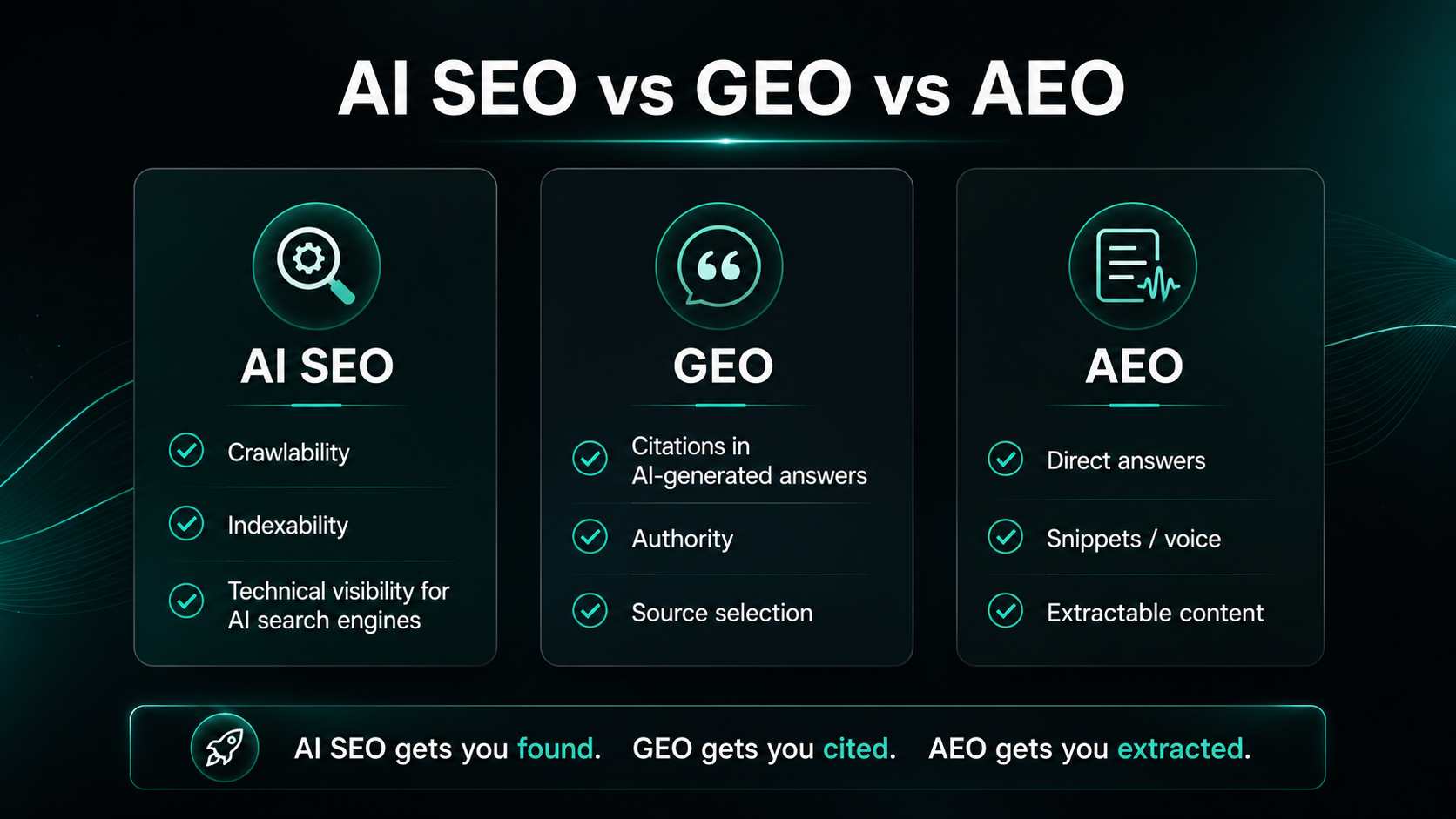
AEO targets snippets and voice search. GEO targets AI engines like ChatGPT, Perplexity, and Gemini.

📌 Key Takeaways

GEO is the practice of getting your brand cited in AI-generated answers. Brands building content depth, named authorship, off-site reputation, structured data, and cited statistics now will have a stronger advantage as AI search grows.

The Complete Guide to Visibility in the AI Search Era

Something unprecedented happened in search during 2025. For the first time since Google launched in 1998, ranking number one no longer guaranteed visibility. A brand could hold the top organic position for its most valuable keyword and watch 58% of the potential clicks vanish — taken by an AI Overview that answered the question before anyone reached the search results. Meanwhile, a competitor with a weaker domain authority but better-structured content and stronger off-site brand signals appeared in ChatGPT, Perplexity, and Google AI Mode — platforms where the organic ranking meant almost nothing.

This is the new search reality. And it demands a new optimisation discipline.

AI search engine optimization is the practice of making your brand visible, cited, and recommended across every AI-powered search surface — from Google AI Overviews to ChatGPT to voice assistants. It combines the technical and content foundations of traditional SEO with the entity signals, structured data, and off-site authority patterns that AI retrieval systems evaluate when generating answers. According to Superlines’ 2026 AI Search Statistics report, AI referral traffic now accounts for 1.08% of all website traffic and is growing roughly 1% month over month. ChatGPT drives 87.4% of that traffic. AI Overviews appear in 25.11% of all Google searches, up from 13.14% in March 2025. The shift is not predicted. It is measured. And it is accelerating.

This complete guide covers every dimension of AI search optimization: what it means, how each AI platform works, the ranking factors that determine citation, how to structure content for extraction, the content types that earn the most AI citations, measurement frameworks, real-world case studies, common mistakes, and the tools that make AI search visibility trackable and compoundable.

What Is AI Search Engine Optimization?

AI search engine optimization is the systematic practice of ensuring your brand, content, and digital presence a restructured so that AI-powered search platforms — including Google AI Overviews, Google AI Mode, ChatGPT, Perplexity, Microsoft Copilot, Gemini, and voice assistants — surface, cite, and recommend you when users ask questions relevant to your category.

It is not a replacement for traditional SEO .It is the next layer built on top of it. Traditional SEO ensures your content is indexed, authoritative, and discoverable in keyword-based search. AI search optimization ensures that content is extracted, attributed, and recommended inside AI-generated answers — a form of visibility that may produce no direct click but significantly influences brand trust, buyer perception, and down stream purchasing decisions.

The distinction matters because AI search and traditional search operate on fundamentally different logic. Traditional search ranks pages for keywords. AI search retrieves passages for sub-queries and synthesises answers. A brand can rank first on Google and be invisible in ChatGPT. It can have low domain authority and appear in every relevant AI response. As Position Digital’s April 2026 AI SEO statistics analysis documents: 43.2% of pages ranking #1 in Google are cited by ChatGPT — but 28.3%of ChatGPT’s most cited pages have zero organic visibility. These two populations overlap, but they are not the same. Optimising for AI search requires addressing both.

[fs-toc-omit]The Scale of the Shift

The adoption numbers behind AI search are no longer projections. Google AI Mode has reached 75 million daily active users. Perplexity processes 200 million monthly queries and is growing fastest in markets outside the US. ChatGPT's weekly active users surged from 300 million in December 2024 to 800 million by October 2025. Gartner forecasts traditional search engine volume will decline 25% by the end of 2026. Bain and Company report that 60% of searches are completed without users clicking through to any website.

For B2B brands, the shift is particularly acute. According to Sapt. ai's 2026 AI search guide, 90% of B2B buyers now use generative AI tools during their purchasing journey — and half of them start their research in ChatGPT or similar platforms instead of Google. G2's 2026research found the Answer Engine Optimization software category grew over2,000% as businesses scrambled to understand why their pipeline was drying up despite stable Google rankings.

The uncomfortable truth: your competitors are being recommended by AI while your brand does not exist in those conversations.And the gap is widening daily.

AI Search Optimization vs Traditional SEO

Understanding the specific ways AI search optimization differs from traditional SEO is the prerequisite for allocating effort correctly. The two disciplines share signals — but they are not the same discipline and they reward different content behaviours.

Dimension Traditional SEO AI Search Optimization
Primary goal Rank in keyword results list Get cited in AI-generated answers and summaries
Search model Keyword matching → ranked list of 10 links Query fan-out → multi-source retrieval → synthesised answer
Core signal Backlinks, keyword relevance, PageRank Entity authority, brand mentions, content extractability
Content evaluation Page-level relevance to a keyword Passage-level relevance to each sub-query in the fan-out
Authority measure Domain Rating / PageRank (backlink correlation: 0.218) Brand mention diversity (correlation: 0.664) + entity clarity
Success metric Rankings, clicks, organic traffic Citation rate, AI brand mention share, Share of Model
Zero-click impact Loses clicks when AI Overviews fire (58% drop at #1) Earns brand presence inside the answer — no click needed
Content format Keyword-optimised long-form pages Fact-dense, directly answerable, passage-structured content
Freshness weight Moderate for evergreen content High — AI cites content 25.7% fresher than traditional results
Schema requirement Helpful for rich results Essential — FAQ Page, HowTo, Article, Author, Organisation
Off-site signals Backlinks from authoritative domains Brand mentions across Reddit, YouTube, publications, reviews
Competition format 10 results per page 2-4 citations in one synthesised AI response
Tracking tools GSC, Ahrefs, SEMrush — rankings and clicks Profound, Otterly.ai, Superliners — citation rate, Share of Model
Timeline to results 3-12 months 3-6 months for measurable citation presence

The brand mention correlation data in this table is the most counterintuitive finding in AI search research. Brand mentions correlate with AI citation probability at 0.664. Backlinks correlate at 0.218. YouTube mentions specifically carry a correlation of 0.737 — the highest single factor across all platforms, according to Sapt.ai’s 2026 AI search optimization analysis. The entire foundation of traditional link-building SEO is being displaced by something else entirely: multi-source brand presence. A brand discussed consistently on YouTube, Reddit, LinkedIn, and industry publications builds a different kind of authority than a brand with many backlinks — and it is the kind of authority that AI retrieval systems reward most highly.

The practical implication is not that backlinks stop mattering. They still contribute to the organic rankings that remain a prerequisite for Google AI Overviews. But for ChatGPT, Perplexity, and AI Mode, brand mention diversity outweighs backlink quantity by a factor of three. This shifts the strategic priority from link acquisition to brand authority building — and it requires a different playbook.

How Each AI Search Platform Works

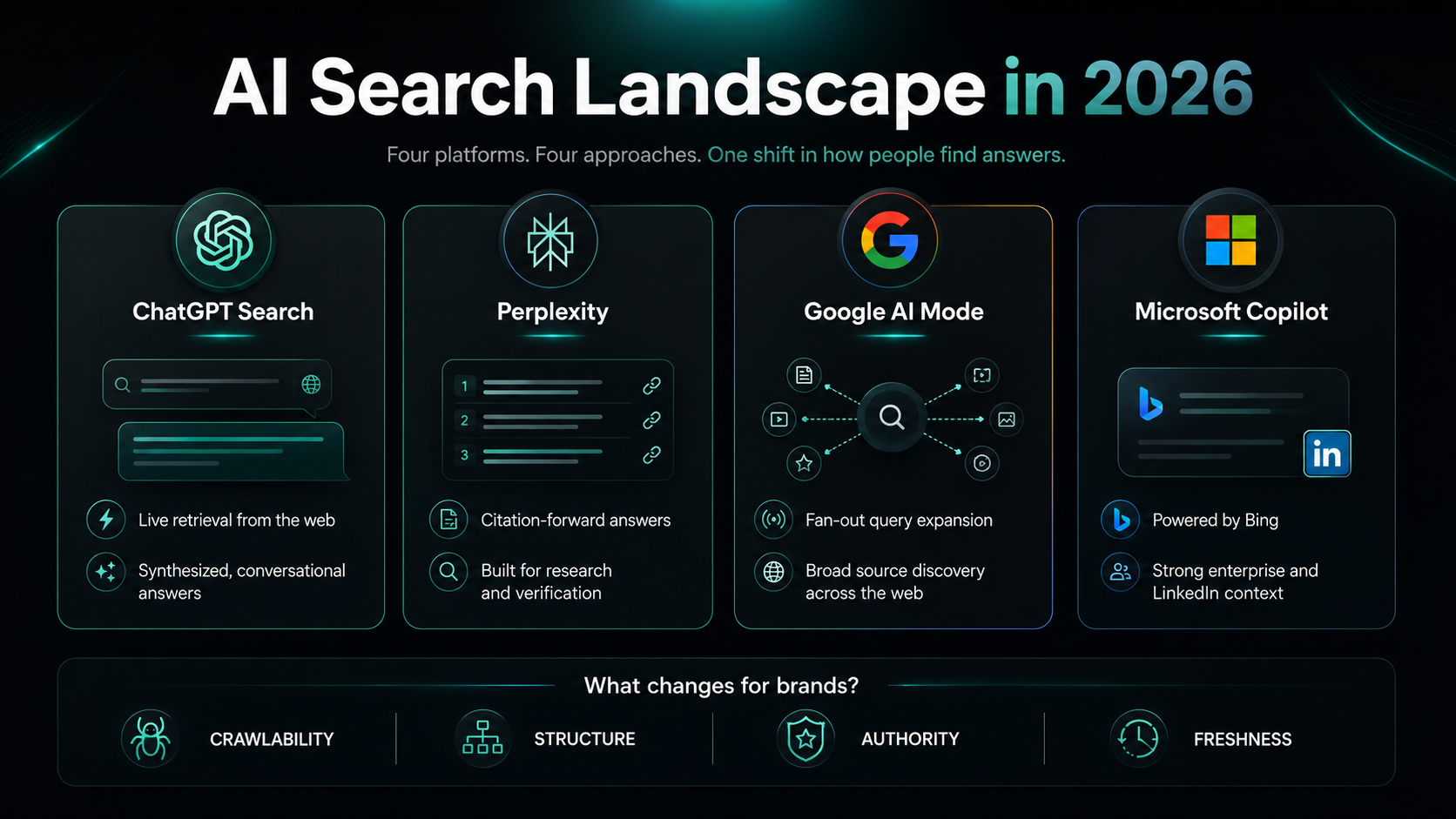
AI search optimization is not one discipline applied uniformly across platforms. Each major AI search surface operates on different retrieval logic, weights different signals, and serves different user populations. Optimising for one and ignoring the others leaves the majority of AI search opportunity uncaptured.

Platform How It Works Optimisation Implication
Google AI
Overviews
Uses Google index in real time; must rank organically (76.1% of AI Overview citations also rank in top 10); selects 40-80 word passages from trusted pages Rank organically first, then add schema + BLUF structure; BrightEdge: citation overlap with organic top-10 grew 32% to 54% in 16 months
Google AI Mode Powered by Gemini 2.5; 75M daily active users; query fan-out generates 9-11 sub-queries; only 14% of cited URLs rank in top 10; expanding citation pool AI Mode is the fastest growing citation surface (up 27% in 5 months, Omnia 2026); opportunity window is widest here — act before competitors close it
ChatGPT
Search
Uses Bing for real-time retrieval; applies own credibility filter; 87.4% of all AI referral traffic; weak correlation with organic rankings 43.2% of pages ranking #1 in Google are cited by ChatGPT; 28.3% of ChatGPT’s most cited pages have zero organic visibility — entity and off-site signals matter most
Perplexity Foregrounds citations; draws heavily from Reddit, news, review platforms; 200M monthly queries; high recency bias; India surpassed US as largest market Community presence on Reddit and LinkedIn is a direct Perplexity ranking signal; 200+ monthly queries; YouTube overtook Reddit as most cited social platform in early 2026
Microsoft
Copilot
Bing infrastructure plus GPT synthesis; two-stage filter: SEO for retrieval pool, extractability for citation; strong LinkedIn signal for B2B queries LinkedIn optimisation is a distinct Copilot ranking lever — brands with active LinkedIn company pages and thought leadership earn B2B Copilot citations at higher rates
Claude / Gemini Training data + real-time retrieval; Gemini grew 157% between April and September 2025; brand citation volumes can vary 615x between Grok and Claude Multi-platform tracking is non-negotiable — the same brand can appear on all platforms or only one; cite verifiable sources to feed training data future updates

The Google AI Mode row deserves particular attention. Based on Omnia’s citation database tracking 42 million citations across four AI engines, AI Mode is the only engine actively expanding its citation behaviour — up 27% in the past five months as of April 2026. AI Overviews have been stable since Q4 2025. Perplexity is down 36% from its November 2025 peak. ChatGPT has declined 30% from mid-2025. As E2M Solutions’ 2026 Google AI Mode optimisation guide frames it: AI Mode is the only surface where new citation slots are opening. That makes this the window to establish presence before the competitive gap widens.

AI Search Ranking Factors

The following table consolidates the primary signals that determine AI search citation and visibility, drawn from academic research, platform-specific citation analysis, and large-scale studies as of April 2026. These are not equally weighted across all platforms — the importance notes reflect where each signal matters most.

AI Search Ranking
Factor
Priority Impact Evidence
Organic ranking (for AIO) Critical Very High 76.1% of AI Overview citations also rank in top 10 — SEO remains AIO prerequisite (Ahrefs, 2025)
Direct answer in first
40-60 words
Critical Very High 55% of AI Overview citations from first 30% of content (Search Engine Land, 2025); answer first always
Entity clarity
(Organisation schema)
Critical Very High Consistent brand entity across all platforms resolves knowledge graph uncertainty; sameAs links essential
FAQ Page schema Critical High 3.2x more likely to appear in AI Overviews; maps to Q&A retrieval format across all platforms
Brand mention
diversity
Critical Very High Correlation with AI citation: 0.664 vs backlinks at 0.218 (Averi 2026); YouTube mentions: 0.737 highest factor
Content freshness Critical High AI cites content 25.7% fresher than traditional results; pages updated in past 2 months earn 28% more citations
Factual density with
attribution
Critical High Princeton GEO study: statistics increase citation probability 37%; expert quotes +41%
E-E-A-T signals High High 96% of AI citations from sources with strong E-E-A-T; February 2026 Google Authors update made this explicit
Article + Author
schema (sameAs)
High High Verified author entities increase citation 2.8x; personalises content to knowledge graph records
Static HTML rendering High High 94% AI parse success for static HTML vs 23% for JavaScript-rendered content (Erlin, 2026)
Off-site review
platform presence
High High G2/Capterra presence increases citation probability 3x compared to brands without (SE Ranking, 2025)
Original research /
proprietary data
High High Sites with original data saw 22% visibility increase; being cited in AIO boosted brand clicks 35% (Ranktracker)
Topical cluster
architecture
High Medium-High Bidirectional pillar-cluster links signal topical authority; content addressing 5+ sub-intents = 3.2x citation rate
Page speed under
0.4s FCP
Medium Medium Pages under 0.4s FCP average 3x more citations than slow pages (AI Clicks, 2025)
Internal linking with
descriptive anchors
Medium Medium AI crawlers map topic networks via link structure; Google fan-out patent US11663201B2 cites internal links
Community platform
engagement
Medium Medium Reddit and LinkedIn participation feeds Perplexity and Copilot citations; YouTube most cited social (Adweek 2026)

[fs-toc-omit]The Organic SEO Foundation

A critical clarification on the organic ranking row: SEO is not in competition with AI search optimization — it is its prerequisite for Google surfaces. As Aurelius Media’s analysis of 400+ keywords, which tracked AI mentions across 16 clients, found: when a site ranks on Google’s first page for a keyword, it shows up in ChatGPT and Perplexity responses 77% of the time. For top-three positions, that rises to 82%. The implication is significant: your AI search optimization strategy is, in large part, your SEO strategy. The fundamentals have not changed. The stakes have gotten higher.

But the organic ranking row only tells part of the story. For ChatGPT and Perplexity specifically, only 12% of cited URLs rank in Google's top 10. 80% of LLM citations do not even rank in Google's top 100 for the original query. This means there is a large, addressable AI citation opportunity that exists entirely outside the organic search ecosystem — one that requires entity clarity, brand mention building, and structured content extractability rather than traditional ranking work.

How to Structure Content for AI Search

Content structure for AI search optimization is determined by one overriding principle: AI systems retrieve passages, not pages. They scan for specific text blocks that directly answer individual sub-queries — blocks that are self-contained, factually specific, and immediately extractable without surrounding context. Content written for narrative flow fails this test. Content written for passage extraction passes it.

[fs-toc-omit]The BLUF Principle

BLUF — Bottom Line Up Front — is the structural rule that applies to every section of AI-optimised content. The first sentence of every section must be a complete, standalone answer to the implied question of that section’s heading. Not background. Not context. The answer. Search Engine Land’s 2025 research found that 55% of AI Overview citations come from the first 30% of page content. The content that earns citations is the content that answers first. Every section that opens with four sentences of context before delivering the answer is structurally uncitable compared to a section that delivers the answer in sentence one.

[fs-toc-omit]Question-Phrased Heading

Every H2 and H3 heading in AI-optimised content should be written as the specific question it answers — mirroring exactly how a user would phrase that query to ChatGPT or a voice assistant. "Key Features" tells a human what the section covers. "What are the key features of X that matter most for remote teams?" maps directly to a sub-query the AI generates when retrieving information about X for that context. Each question-phrased heading is a citation target, not a navigation label.

[fs-toc-omit]Optimal Passage Length

• AI Overview passages: 40-80 words — directly answerable, factual, attributable without surrounding context

• Featured snippet paragraphs: 40-60 words — complete standalone answer, no qualifying clauses at the start

• ChatGPT / Perplexity passage chunks: 100-167 words — the optimal semantic chunk size for passage-level LLM retrieval

• Voice assistant answers: 20-30 words — must sound natural when read aloud; complete sentence; no lists

[fs-toc-omit]Factual Density Requirement

The Princeton GEO study found that adding statistics increases AI citation probability by 37%, expert quotes by 41%, and source citations by 30%. The practical implementation: at least one verified, named-source statistic every 150-200 words throughout the content. Not orphaned numbers — attributed claims in the format: "[statistic] according to [named source, year]." Specific, sourced, verifiable facts are what AI systems select as citable passages. Vague assertions are what they pass over.

[fs-toc-omit]Comparison Tables

Comparison tables are the highest-performing content format for commercial and evaluative AI search queries. AI models extract tabular data more reliably than prose for side-by-side evaluations. A well-structured comparison table — clear column headers representing options, row labels representing evaluation criteria, cells containing specific quantifiable data — earns citations across multiple sub-query types simultaneously: the comparison query, the individual option queries, and the evaluation criteria queries. For any competitive category, a comparison table is not optional — it is the content format most likely to be cited for commercial-intent queries.

Content Types That Earn AI Citations

Not all content performs equally in AIsearch. The following table maps content types to their AI citation value and explains the mechanism behind each:

Content Type AI Citation Value Why and How It Earns Citations
Category definitions
/ explainers
Very High AI systems use definitional content as primary reference material; brands that define categories become default citations for those categories
Original research
and data reports
Very High Sites with original data saw 22% visibility increase; cited statistics propagate across the web, feeding AI training and retrieval
Comparison and
alternative content
High Case studies and pricing pages are best content types for AI-era traffic (Siege Media, 2025); comparison tables extracted directly
Use-case specific
guides
High Specificity earns citations — “CRM for construction firms” outperforms “CRM software” for concentrated AI citation
FAQ-rich reference
articles
High FAQPage schema + direct Q&A format = highest consistent citation rate across all major platforms
Step-by-step
instructional guides
High HowTo schema retrieved 6.4x more than paragraph guides; captures procedural and voice search queries simultaneously
Case studies with
named outcomes
High Named brands, specific metrics, verifiable results; case studies earn evaluative-intent citations that build commercial trust
Expert commentary
and analysis
Medium-High Expert quotes boost AI visibility 41% (Princeton GEO study); first-hand expertise satisfies E-E-A-T experience requirement
Thought leadership
/ opinion pieces
Medium Builds off-site brand mentions and LinkedIn presence; indirect AI authority signal rather than direct citation driver
News and trending
topic content
Low-Medium High recency value for Perplexity; low evergreen citation potential; avoid for sustained AI search authority building

The case studies and pricing pages finding from Siege Media’s September 2025 analysis deserves emphasis. Top-of-funnel informational content — “what is,” how-to guides, and broad explainers — saw massive traffic drops in the past two years as AI systems answer these queries directly without sending users to websites. Bottom-of-funnel content — case studies with named outcomes, specific pricing comparisons, and implementation guides — drives AI-era traffic because it contains the specific, verifiable, commercially relevant information that AI systems cannot generate from training data alone. Brands that redirect content investment toward case studies, pricing transparency, and implementation specifics are building the content library that earns AI citations for high-intent commercial queries.

Building AI Search Authority: The Off-Site Dimension

No amount of on-page optimisation compensates for the absence of off-site authority signals in AI search. AI systems evaluate brand credibility based on how a brand is discussed across the broader digital ecosystem — not just how its own website is structured. Building that off-site presence is the strategic dimension that most AI search conversations underemphasise.

[fs-toc-omit]The Brand Mention Imperative

Brand mentions correlate with AI citation probability at 0.664 — more than three times the correlation of backlinks at 0.218. YouTube mentions specifically carry a 0.737 correlation — the highest single factor. Reddit and LinkedIn presence feeds Perplexity and Copilot citations directly. Distributing content to a wide range of publications can increase AI citations by up to 325% compared to publishing only on your own site, according to Stacker’s December 2025 research cited by Omnia’s AI Mode guide. These numbers describe a multi-source brand presence strategy — not a link-building strategy.

[fs-toc-omit]Platform-Specific Off-Site Strategy

YouTube: Overtook Reddit as the most cited social platform in AI responses in early 2026 (Adweek). Create video content on topics buyers research; include full transcripts for text-based AI retrieval; add Video Object schema.

Reddit: Historically the most cited social domain; Perplexity draws heavily from Reddit threads. Identify two to three subreddits where your buyers discuss problems in your category. Contribute substantive guidance — not promotional content.

LinkedIn: Microsoft Copilot draws heavily from LinkedIn for B2B queries. Well-maintained company pages with consistent brand descriptions and active thought leadership posts are a direct Copilot optimisation signal. B2B brands underinvesting in LinkedIn are leaving Copilot citations uncaptured.

Review platforms: G2 and Capterra listings increase ChatGPT citation probability 3x (SE Ranking, 2025). The listing takes hours to create and provides a permanent independent verification signal that AI systems treat as category authority.

Industry publications: Digital PR targeting topic-relevant publications — not just high-DA domains — creates brand mentions in the exact context where you want to be cited. A mention on a domain that AI Mode frequently cites for your topic category carries more weight than a generic authority link.

Original research: Sites with original data saw a 22% visibility increase, and being cited in an AI Overview boosted brand clicks by 35% (Ranktracker, 2026). Original research creates a citation asset that propagates across the web — other sites cite it, AI systems retrieve those citations, and your brand gains multi-source corroboration that compounds over time.

Technical AI Search Optimization

Technical AI search optimization covers the infrastructure that enables AI systems to access, parse, and confidently retrieve your content. Without it, the best content in the world earns zero citations. With it, every content and authority investment is amplified.

[fs-toc-omit]Crawl Access

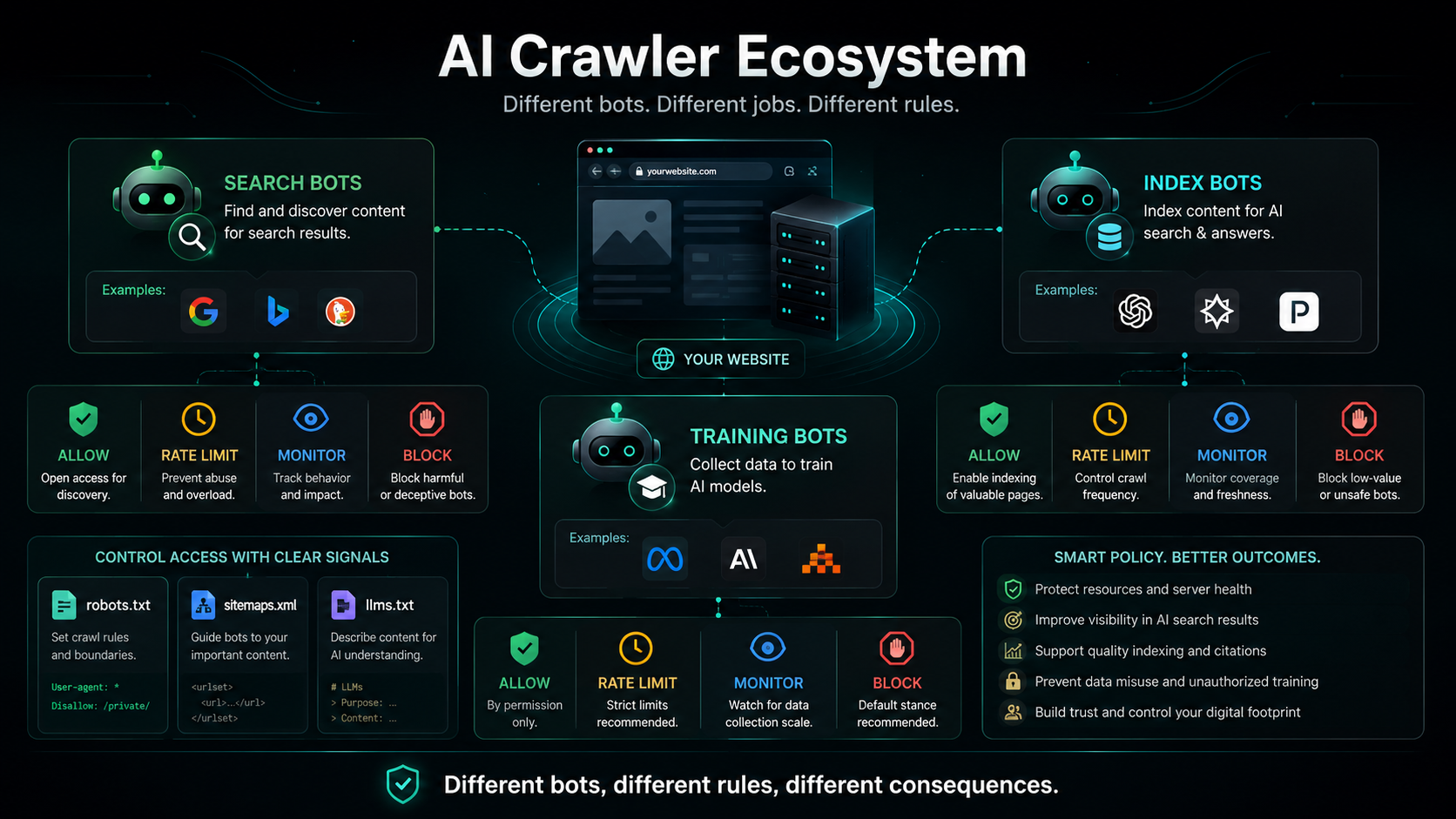
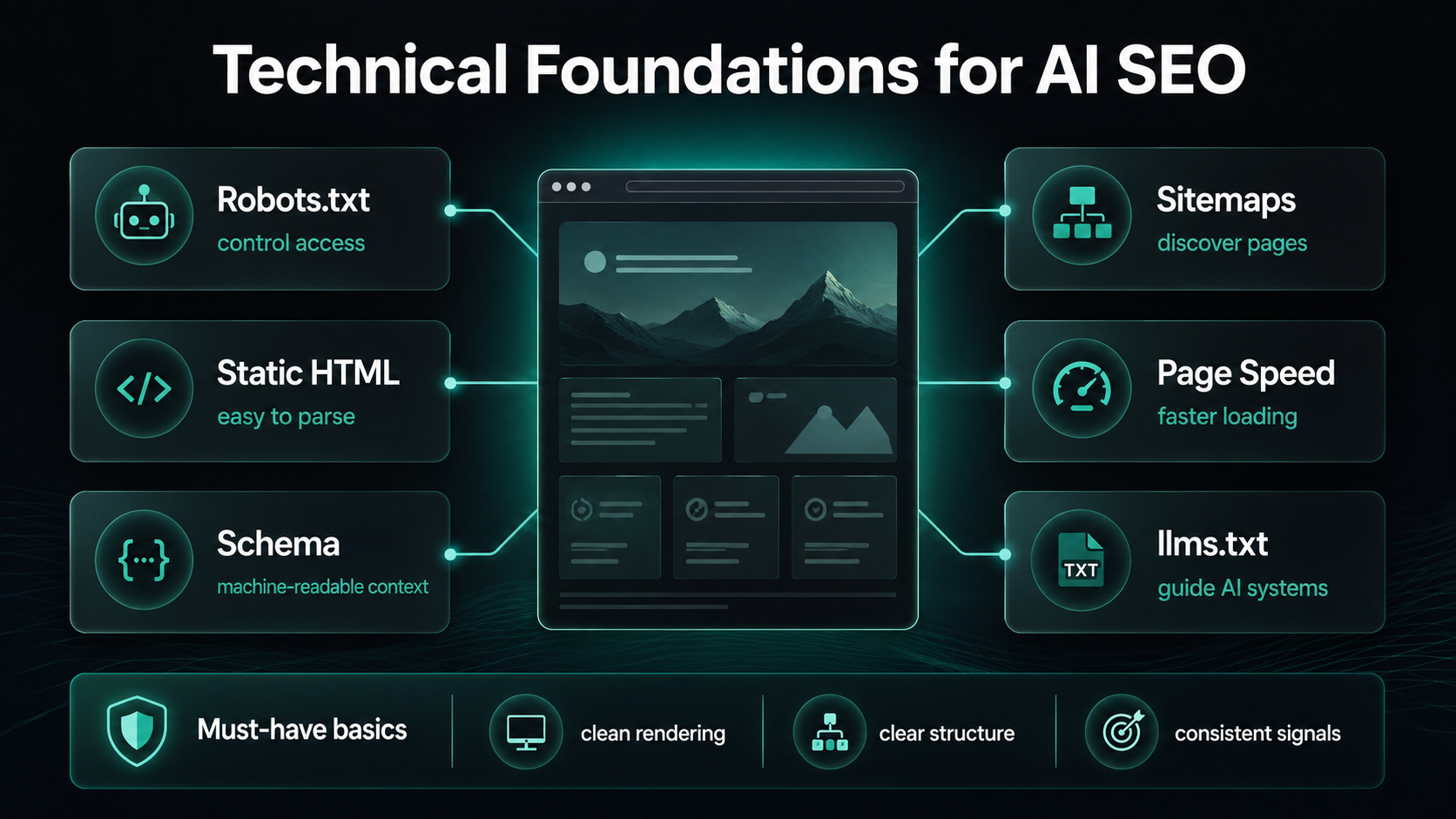
The first and highest-leverage technical action: check your robots.txt file for any rules blocking GPT Bot, Perplexity Bot, Claude Bot, or Google-Extended. These blocks — often introduced accidentally through catch-all bot-blocking rules — remove your brand entirely from the AI systems that could be citing you. Remove them before doing anything else. This single action costs nothing and can produce immediate citation improvement for brands that have been inadvertently blocking AI crawlers.

[fs-toc-omit]Static HTML Rendering

AI parsing success for static HTML runs at 94% versus JavaScript-rendered content at 23% (Erlin, 2026). If your site relies on client-side JavaScript rendering, AI systems may be unable to extract your content regardless of its quality or schema implementation. Server-side rendering or static HTML generation is the technical prerequisite for reliable AI search performance. This is not a new optimisation — it is a baseline infrastructure requirement that became critical when AI became a primary search surface.

[fs-toc-omit]Page Speed

Pages loading under 0.4 seconds First Contentful Paint average 3 times more AI citations than pages loading over 1.13 seconds, according to AI Clicks' 2025 citation analysis. Page speed is not only a user experience metric in 2026 — it is a direct AI citation signal. Compress images, remove render-blocking scripts, use a CDN, and prioritise critical CSS. The investment pays returns across both traditional SEO and AI search.

[fs-toc-omit]Schema Markup

Schema markup is the technical layer that makes your content machine-readable — converting it from text that AI systems must interpret to structured data they can read with certainty. The correct implementation is JSON-LD in a single @graph block containing Organisation, Article, Author (Person), FAQ Page, and How to schema as relevant. All same As links must connect to live, verified profiles. Every property must match visible page content exactly — mismatches create trust penalties that reduce citation confidence.

[fs-toc-omit]The llms.txt Standard

An emerging technical signal is the llms.txt file — a plain-text file at your domain root that guides AI systems toward your most authoritative pages. Similar to robots.txt for traditional crawlers, llms.txt communicates to AI systems which pages represent your canonical expertise and which content has been optimised for AI retrieval. Implementation takes under an hour. As Semrush’s 2026 AI search optimization guide notes, concrete steps like properly attributing statistics produce faster AI citation improvements than speculative tactics. llms.txt is one of the few technical AI signals with measurable impact and no risk.

AI Search Optimization Checklist

The following 30-point checklist consolidates every AI search optimization action in priority order. Use it as a comprehensive audit framework for building AI search visibility:

# AI Search Optimization Action Priority
1 Allow GPT Bot, Perplexity Bot, Claude Bot, Google-Extended in robots.txt Critical
2 Ensure pages render as static HTML — avoid JavaScript-only content delivery Critical
3 Confirm pages load under 0.4s FCP — compress images, remove render-blocking JS Critical
4 Build organic top-10 rankings for core queries — SEO remains AIO prerequisite Critical
5 Open every section with a standalone direct answer in 40-60 words Critical
6 Write H2/H3 headings as natural questions that mirror actual user queries Critical
7 Implement Organisation schema with sameAs links (LinkedIn, Wikidata, Crunchbase) Critical
8 Implement Article + Author (Person) schema with sameAs on all content pages Critical
9 Implement FAQ Page schema on all pages addressing common questions Critical
10 Combine all schema types in a single JSON-LD @graph block Critical
11 Add HowTo schema to all instructional and process-based content Critical
12 Include one verified, named-source statistic every 150-200 words Critical
13 Add a visible Last Updated date to all strategic pages High
14 Cite credible external sources (academic, government, industry) within content High
15 Add comparison tables for evaluative / commercial queries High
16 Add FAQ section at the bottom of every key page High
17 Build pillar + cluster architecture with bidirectional internal links High
18 Use descriptive anchor text on all internal links — no generic 'read more' High
19 Get listed on G2, Capterra, Trustpilot, or relevant review platform High
20 Contribute expert commentary to 3+ credible industry publications High
21 Build active presence on Reddit in communities your buyers use High
22 Publish original research or proprietary data that others can cite High
23 Optimise LinkedIn company page and publish regular thought leadership posts High
24 Create a YouTube channel with video content and full transcripts Medium
25 Build an llms.txt file guiding AI crawlers toward authoritative pages Medium
26 Assign consistent @id values to recurring entities across all schema Medium
27 Validate every schema implementation with Google’s Rich Results Test Medium
28 Set up GA4 custom channel group: Generative AI (filter by chat.openai.com etc.) Ongoing
29 Track AI citation rate monthly across ChatGPT, Perplexity, Gemini, AI Mode Ongoing
30 Refresh key pages quarterly — update statistics, examples, and datelines Ongoing

Measuring AI Search Performance

Traditional SEO metrics — rankings, clicks, organic sessions — do not capture AI search visibility. A brand can earn consistent ChatGPT citations for its most valuable queries while showing no measurable change in organic traffic, because AI-referred traffic arrives through different channels and often does not register as a click at all. AI search optimization requires a new measurement framework.

AI Search Metric What It Measures How to Track It
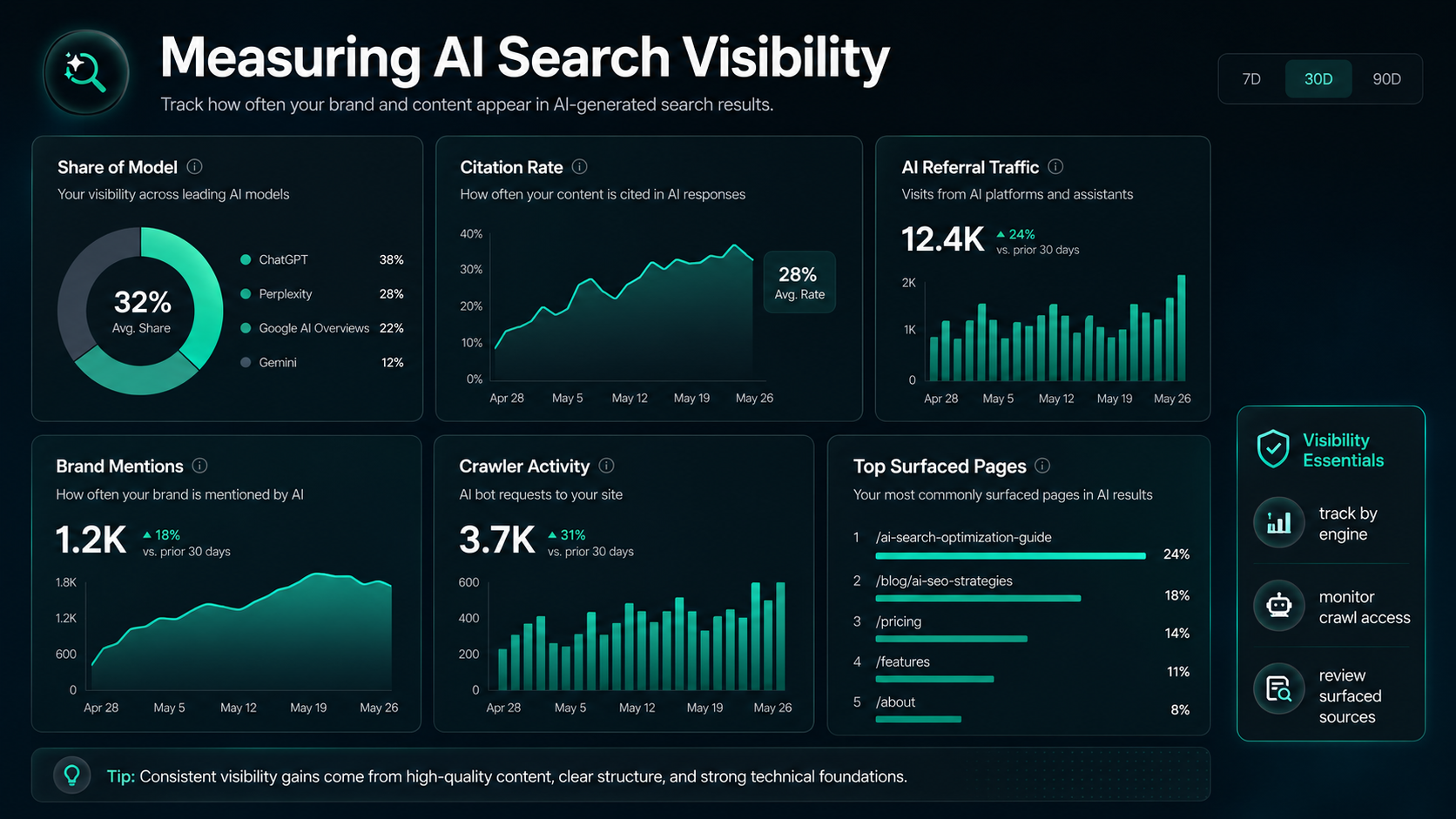
Share of Model (SoM) How often your brand is mentioned when AI discusses your category vs competitors Set 30-40 target prompts; track brand mention rate monthly across ChatGPT, Perplexity, AI Mode
Citation Rate Percentage of relevant AI responses that cite your content with a source link Run target queries monthly; record citation presence; use Profound or Otterly.ai for scale
AI Referral Traffic Sessions arriving from AI platforms (chat.openai.com, perplexity.ai, etc.) Create GA4 custom channel: Generative AI; filter by known AI referral domains
AI Visitor Conversion Rate How AI-referred visitors convert vs organic baseline (industry avg: 4.4x higher) Segment AI referral sessions in GA4; compare goal completion rates vs organic channel
Sentiment Accuracy How AI characterises your brand when mentioning it — positive, neutral, or inaccurate Manually check AI responses for brand description; flag hallucinations; test monthly
Featured Snippet Capture How many target queries return your content as the featured snippet Monitor via SEMrush or Ahrefs; cross-reference with GSC high-impression/low-click queries
Brand Mention in AI Text Whether AI mentions your brand name in the answer text, separate from source citations Distinct from citation rate — Growth Memo: AI Mode mentions brands 37.6% but cites 76.3%
Competitive Citation Share Your AI citations vs competitor citations for the same target queries Profound, Superlines, or Omnia provide competitive share-of-voice across AI platforms
[fs-toc-omit]Setting Up GA4 for AI Search Tracking


For citation-level tracking at scale, Profound leads enterprise AI citation monitoring with the highest AEO score in G2’s Winter 2026 report. Superlines compiles 60+data points across platforms. Omnia provides competitive citation share data updated daily. For brands early in their AI search journey, monthly manual testing of 20-30 target prompts across ChatGPT, Perplexity, and Gemini produces sufficient signal to track progress and identify content gaps.

AI Search Optimization Case Studies

The following case studies document real-world AI search visibility results across industries, drawn from published research, platform analyses, and documented brand outcomes:

Brand Category Strategy Outcome
Stripe Fintech / Payments Comprehensive content covering all payment processing intent layers; strong entity clarity; consistent brand signals Significantly outperformed competitors in AI search visibility across ChatGPT, Perplexity, AI Mode, and Gemini (ALM Corp, Dec 2025)
NerdWallet Personal Finance Shifted to direct expert answers for common financial queries; FAQ schema throughout; E-E-A-T signals on all pages Maintained revenue growth despite AI-driven traffic pressure; became default finance answer source across AI platforms
Ulta Beauty Beauty / E-commerce Shifted to educational ingredient-focused content answering AI platform questions; FAQ schema; cited dermatological sources AI visibility index reached 319.0 by January 2026 — more than triple April 2025 baseline; fastest growing in beauty sector
B&H Photo Electronics / Retail Deep specialist content for technical sub-queries incumbents ignored; camera comparisons; lens guides; audio specs AI visibility index 296.9 by January 2026 — nearly triple baseline despite ranking 7th in electronics sector overall
Washington Post Media / Publishing Optimised content for AI citation; structured extractable passages; clear authorship; allowed AI crawlers AI-referred visitors converted to subscriptions at 4-5x the rate of traditional search visitors (Karl Wells, CRO)
Enrich Labs B2B / GEO Agency Published authoritative GEO cluster content; schema on all pages; off-site authority building; original data AI engines send 2,200+ sessions/month from ChatGPT, Perplexity, Gemini, Claude — without traditional search rankings

The consistent pattern across all six cases: comprehensive, structured, entity-consistent content combined with off-site brand presence produces compounding AI search visibility. The Washington Post case illustrates the conversion quality dimension that makes AI search commercially significant: Karl Wells, Chief Revenue Officer of the Washington Post, reported that visitors arriving from AI platforms converted to subscriptions at 4 to 5 times the rate of traditional search visitors. This conversion rate advantage is the commercial rationale for AI search investment beyond brand awareness.

Common AI Search Optimization Mistakes

Mistake 1 — Treating AI search optimization as entirely separate from SEO. The two are layered, not competing. Google AI Overviews require organic ranking as a prerequisite. Brands that invest in AI-specific tactics while neglecting their SEO foundation will earn Perplexity and ChatGPT citations but miss the largest AI answer surface — Google AI Overviews — entirely. The correct sequence: strong SEO foundation first, AI-specific signals layered on top.

Mistake 2 — Chasing AI-specific tactics without evidence. As Aurelius Media’s AI SEO strategy analysis documents plainly: the agencies selling “AI SEO” as a completely separate discipline are full of tactics — restructure headings as questions, get onto Reddit and Wikipedia, implement AI-specific schema — that studies show have no measurable effect on AI visibility in isolation. The brands quietly appearing in AI search results are doubling down on fundamentals: quality content, topic authority, and third-party validation. Tactics without a strong content and SEO foundation produce no AI visibility benefit.

Mistake 3 — Publishing AI-generated content without expert editing. After the March 2026 core update, mass-produced unedited AI content saw a 71% traffic drop (Rank tracker, 2026). AI-generated content without genuine expertise, original insight, and human editing is increasingly penalised across both traditional search and AI citation systems. Content that wins AI citations demonstrates first-hand experience and subject-matter depth — signals that AI-generated content without expert review cannot provide.

Mistake 4 — Building off-site presence only on your own website. 85% of AI brand mentions originate from third-party sources (Search Engine Land, 2025). A brand whose entire digital footprint is its own website is structurally invisible to the off-site authority signals that determine AI citation confidence. Building genuine, substantive presence across community platforms, publications, and review sites is not an optional bonus — it is the structural requirement for sustained AI search visibility.

Mistake 5 — Treating content as a one-time investment. Pages not updated quarterly lose AI citations at 3 times the normal rate. AI search has a strong recency bias: content published once and never updated steadily loses citation probability as competitor content is refreshed and AI platforms recalibrate toward current sources. Quarterly content reviews are not editorial housekeeping — they are an AI search ranking action.

Mistake 6 — Measuring AI search performance using only traditional metrics. Brands that measure AI search optimization purely through clicks and organic sessions will consistently undervalue its contribution. AI search earns brand association and authority at the point buyers form purchase preferences — before any click, often before any website visit. Implementing a proper AI search measurement framework (Share of Model, citation rate, AI referral conversion quality) is the prerequisite for evaluating the strategy correctly and investing in it appropriately.

The Future of AI Search: 2026 and Beyond

Agentic AI search will change the stakes. The next frontier in AI search is not answer generation — it is task completion. OpenAI released an Agentic Commerce Protocol. Shopify integrated one-click AI agent checkout. GPT Bot and Perplexity Bot crawl the web to complete tasks on behalf of users, not just index content. A user can tell an AI agent: “Find the best B2B marketing agency in my city that specialises in e-commerce SEO and book a consultation.” The agent browses, evaluates, and books without the user opening a browser tab. The brands appearing in those agent workflows will be the ones that have built strong AI search visibility before agents become the default interface.

Multimodal AI search will expand. AI engines are increasingly processing images, video, and audio alongside text. YouTube overtook Reddit as the most cited social platform in early 2026. Video content with transcripts, image alt text optimisation, and audio content with structured metadata are becoming AI search signals. The brands that extend their content programmes to multimodal formats will build citation advantages in the emerging visual and voice AI search landscape.

AI search personalisation will deepen. As AI platforms learn individual user preferences, the same query may return different answers for different users. This increases the importance of semantic depth over keyword targeting — content that satisfies the full latent intent network behind a query performs across personalisation variations in ways that single-intent, keyword-optimised content cannot. The shift from optimising for queries to optimising for intent networks will become the defining content strategy challenge.

The measurement gap will close — then widen. Currently, most brands have no visibility into their AI search performance. As attribution tools mature and as AI referral traffic grows in absolute volume, measurement will improve. But the brands that establish AI search authority now — before measurement becomes standardised — will have citation advantages that are structurally difficult for late-movers to close. The compounding nature of AI citation authority mirrors the compounding nature of domain authority in traditional SEO: early investment produces advantages that take years of sustained competitor effort to overcome.

The brands that invest in AI search optimization in 2026 are not just optimising for today’s search landscape. They are building the structured, authoritative, multi-source digital presence that determines visibility across every AI interface that emerges over the next decade. The window for first-mover advantage is open now. It will not remain open at this scale indefinitely.

Frequently Asked Questions

[fs-toc-omit]What is AI search engine optimization?

AI search engine optimization is the practice of structuring content, building technical infrastructure, and establishing off-site authority so that AI-powered search platforms — including Google AI Overviews, Google AI Mode, ChatGPT, Perplexity, Microsoft Copilot, and voice assistants — select, cite, and recommend your brand when generating answers to user queries. It extends traditional SEO by adding GEO (Generative Engine Optimization) and AEO (Answer Engine Optimization) as additional layers targeting AI-specific retrieval signals.

[fs-toc-omit]Is AI search optimization different from traditional SEO?

Yes, significantly. Traditional SEO targets keyword rankings in a list of blue links measured by clicks and organic traffic. AI search optimization targets citation and brand mention presence inside AI-generated answers, measured by citation rate, Share of Model, and AI referral conversion rate. The disciplines are complementary: strong SEO remains the prerequisite for Google AI Overview inclusion, but 28.3% of ChatGPT's most cited pages have zero organic visibility — meaning AI search optimization requires additional signals beyond SEO alone, including entity clarity, brand mention diversity, and structured content extractability.

[fs-toc-omit]Does SEO still matter in an AI search world?

Yes. Traditional SEO remains essential fortwo reasons. First, Google AI Overviews draw predominantly from organically ranking pages — 76.1% of AI Overview citations also rank in the top 10 of organic results. Without organic ranking, you are ineligible for the largest AI Overview surface. Second, the technical signals that earn traditional rankings— site health, backlinks, content depth — also feed the authority signals that AI retrieval systems use. However, SEO alone is no longer sufficient. Brands appearing in ChatGPT and Perplexity need additional AI-specific signals: entity clarity, brand mention diversity, and passage-level content extractability, all of which SEO does not address.

[fs-toc-omit]How do I get my brand cited by ChatGPT?

Getting cited by ChatGPT requires three parallel workstreams. First, build organic ranking for your core queries —ChatGPT uses Bing for real-time retrieval, and the correlation between Googletop-3 rankings and ChatGPT mentions is 82% according to Aurelius Media's 2026analysis of 400+ keywords across 16 clients. Second, ensure your content is structured with direct answers in the first 40-60 words of every section, question-phrased headings, and FAQ Page schema. Third, build off-site brand mentions — brand mention diversity correlates with AI citation probability at0.664 versus backlinks at 0.218.

[fs-toc-omit]What is Share of Model (SoM) and why does it matter?

Share of Model (SoM) is the metric that measures how frequently your brand appears when AI systems discuss your productor service category, relative to competitors. It is the AI search equivalent of market share of voice in traditional media. SoM matters because it captures brand visibility at the point buyers form purchase preferences — inside AI-generated research summaries — before any click or website visit occurs. Brandi AI's 2026 trends report projects that by late 2026, a significant gap will emerge between brands with high SoM and those invisible in AI conversations, directly affecting pipeline and revenue.

[fs-toc-omit]How long does it take to see results from AI search optimization?

Technical changes — schema implementation,robots.txt fixes, static HTML rendering — take effect after the next AI crawler visit, typically within days to weeks. Structural content changes — BLUF formatting, question headings, FAQ sections — produce measurable citation improvements within four to eight weeks for pages that already rank organically. Off-site authority building — publications, community engagement, review platform listings — operates on a three-to-nine month compounding horizon. Full AI search visibility across ChatGPT, Perplexity, Google AI Overviews, and AI Mode typically becomes consistently measurable within three to six months of integrated implementation.

[fs-toc-omit]What are the most important AI search ranking factors?

Based on the most current citation research as of April 2026: (1) organic ranking for Google AI Overview eligibility —76.1% of AIO citations also rank in top 10; (2) direct answer in first 40-60words — 55% of AI citations come from the first 30% of content; (3) brand mention diversity — 0.664 correlation with AI citation probability, three times higher than backlinks; (4) entity clarity via Organisation and Author schema with same As links — 2.8x citation lift from verified author entities; (5)content freshness — AI cites content 25.7% fresher than traditional results, with 28% more citations for pages updated in past two months.

[fs-toc-omit]Can small businesses compete in AI search?

Yes — more effectively than in traditional SEO. AI search rewards answer clarity, structural precision, and topical authority depth over raw domain authority. B&H Photo nearly tripled its AI visibility index despite ranking seventh in its sector by building specialist content depth in technical categories incumbents ignored. Only 274,455 domains have ever appeared in Google AI Overviews out of 18.4 million indexed sites —meaning the vast majority of businesses have not yet optimised for AI search. A small business with genuine expertise, structured content, and consistent off-site presence in its specific niche can earn AI citations ahead of larger competitors who have not addressed these signals.

[fs-toc-omit]How do I track AI search performance?

AI search performance requires a new measurement framework beyond traditional SEO metrics. Set up a GA4 custom channel group labelled Generative AI using source filters for chat. openai.com, perplexity.ai, and other AI referral domains. Track citation rate by running30-40 target prompts monthly across ChatGPT, Perplexity, Gemini, and AI Modeand recording brand appearances. Use Profound, Otterly.ai, or Superliners for automated citation tracking at scale. Monitor AI referral conversion rate separately — industry data shows AI-referred visitors convert at 4.4 times the rate of standard organic visitors and spend 68% more time on site.

Dive Deeper

No items found.

Related Case Studies