.svg)
.svg)

Content Chunking for LLM SEO
How to structure pages for better AI retrieval — including the 256–512 token evidence, four chunking strategies, answer density, six structural requirements, and the audit that identifies sections limiting AI visibility.
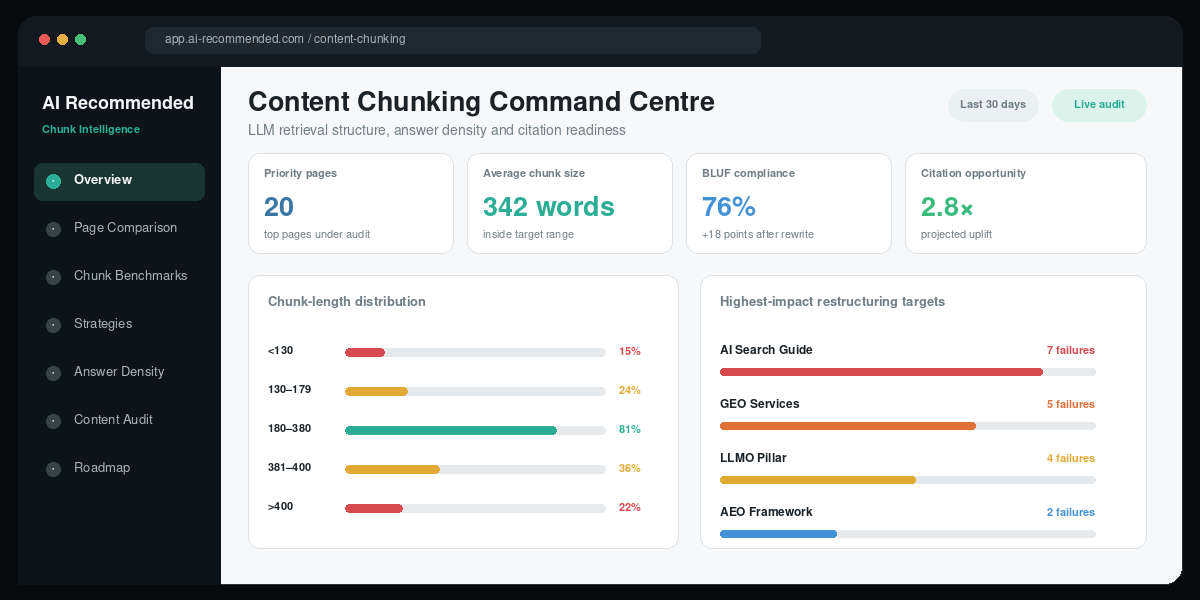
When an LLM answers a question, it does not necessarily evaluate an article as one uninterrupted document. Retrieval systems identify individual passages, score them independently, and pass only the strongest candidates into the final answer-generation stage.
A page with six focused, self-contained H2 sections can create six strong retrieval candidates. A page containing the same information inside one long section may create only one diluted candidate.
This article belongs to the LLM Optimization pillar. To understand the stages before and after chunk creation, continue with How Large Language Models Understand Content, Semantic SEO for LLMs, and Embeddings and Vector Search Optimization.
What Do the Content Chunking Numbers Show?
The evidence points to a practical middle range: enough space to answer one meaningful question completely, but not enough space for multiple unrelated concepts to dilute the section’s semantic focus.
What Is Content Chunking in LLM SEO?
Direct answer: Content chunking is the deliberate organisation of a page into logical, self-contained sections. Google Cloud documents chunk-based retrieval for RAG systems, where document content can be parsed into retrievable chunks that AI systems can independently crawl, embed, retrieve, understand, and cite.
In practical web content, an H2 heading and its supporting paragraphs often act as a natural chunk boundary. The heading provides the contextual label, while the section body supplies the direct answer, evidence, and detail. Google Document AI’s layout parser explicitly preserves document hierarchy when creating context-aware chunks, while Azure AI Search distinguishes fixed, layout-aware, and semantic chunking approaches.
Poor chunking creates a retrievability gap. The page may contain the correct information, but the answer is buried inside background, mixed with unrelated topics, dependent on an earlier paragraph, or unavailable to AI crawlers. Anthropic’s Contextual Retrieval research demonstrates why isolated chunks can lose necessary document context and why short chunk-specific context can improve retrieval performance.
Read the foundational sub-article: What Is Content Chunking in LLM SEO?
What Is the Difference Between Poor and Effective Chunking?
The information may be identical, but the structure changes how easily a retrieval system can isolate the answer, understand its subject, and use it without the surrounding page.
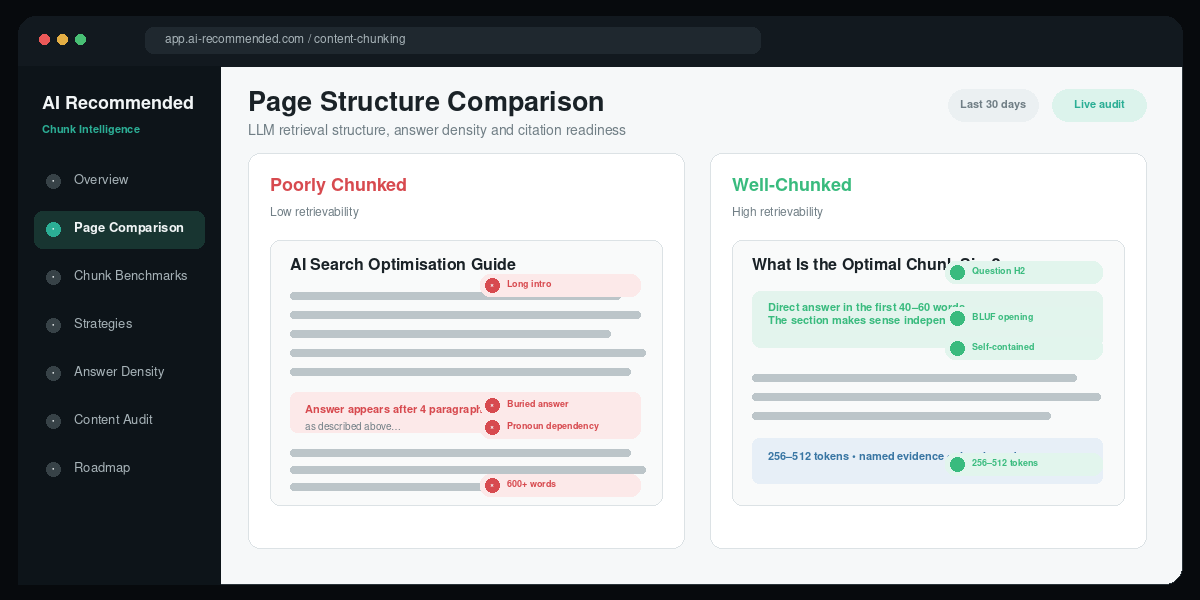
| Poorly Chunked Content | Well-Chunked Content |
|---|---|
| Long introduction before the section answers its heading. | Direct answer appears inside the first 40–60 words. |
| One section continues for more than 600 words and covers several intents. | One H2 section resolves one distinct question in approximately 180–380 words. |
| Uses phrases such as “as mentioned above” or “this approach”. | Uses explicit nouns so the section makes sense independently. |
| Contains dense background prose with few specific facts. | Uses definitions, named evidence, factual tables, and actionable steps. |
| Has no clear semantic boundary before the next topic begins. | Closes the current answer before introducing the next question-led H2. |
A practical answer-block workflow is available in How to Create Self-Contained Answer Blocks for LLMs.
What Is the Optimal Content Chunk Size for AI Retrieval?
Direct answer: A useful working range for many focused web sections is approximately 256–512 tokens, which often translates to roughly 180–380 English words. This is a starting hypothesis, not a universal optimum. Multi-dataset chunk-size research shows that concise fact retrieval can favour smaller chunks while questions requiring broad context can benefit from larger chunks. Short sections may lose context; large sections may combine several intents and weaken precision.
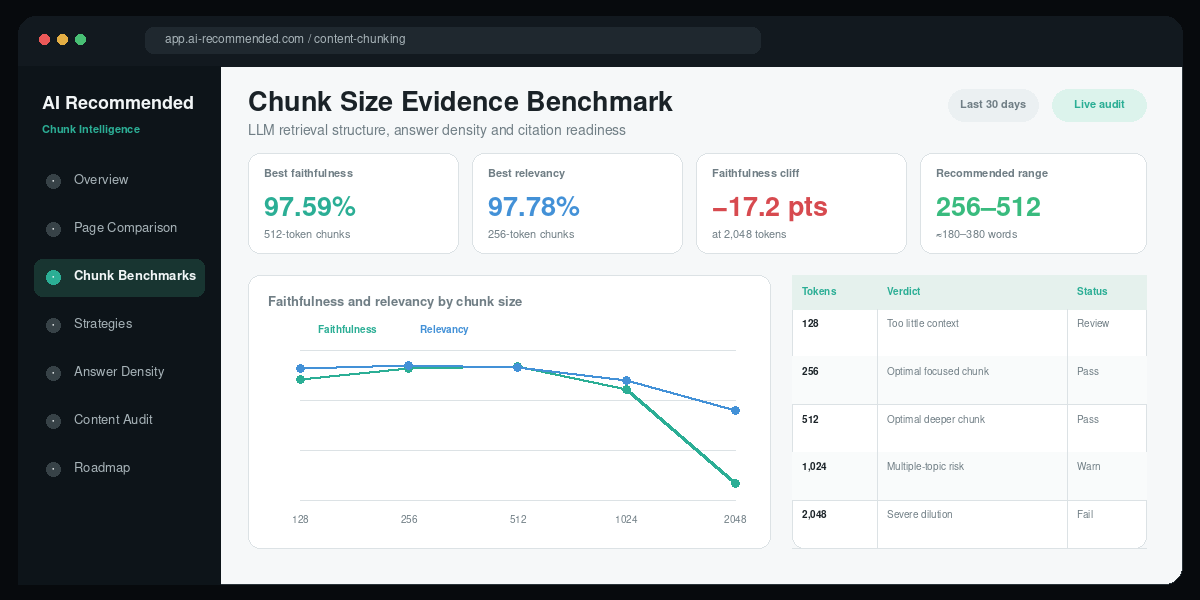
| Chunk Size | Approx. Words | Faithfulness | Relevancy | Practical Verdict |
|---|---|---|---|---|
| 128 tokens | About 95 words | 95.74% | 97.22% | Useful for simple facts, but often too short for complex answers. |
| 256 tokens | About 190 words | 97.22% | 97.78% | Optimal for focused, single-concept sections. |
| 512 tokens | About 380 words | 97.59% | 97.41% | Optimal when the question requires greater explanation depth. |
| 1,024 tokens | About 760 words | 94.26% | 95.56% | Likely to combine several topics and dilute the embedding. |
| 2,048 tokens | About 1,530 words | 80.37% | 91.11% | Poor retrieval performance and severe semantic dilution. |
The recommended range is a diagnostic guide, not a universal standard. Google Cloud notes that the optimal chunking strategy depends on the data and application, not a reason to pad short answers or split a coherent explanation artificially. Semantic completeness and answer density remain more important than hitting an exact word count.
Paragraph-level guidance is covered in Ideal Paragraph Length for LLM SEO. For production systems, Microsoft’s RAG chunking guidance recommends selecting a strategy according to document structure, question type, embedding model, and evaluation results rather than applying one number to every corpus.
Which Content Chunking Strategy Should a Website Use?
Question-led H2 boundary chunking is the strongest default for structured web articles because it preserves semantic meaning and gives every section a natural contextual prefix.
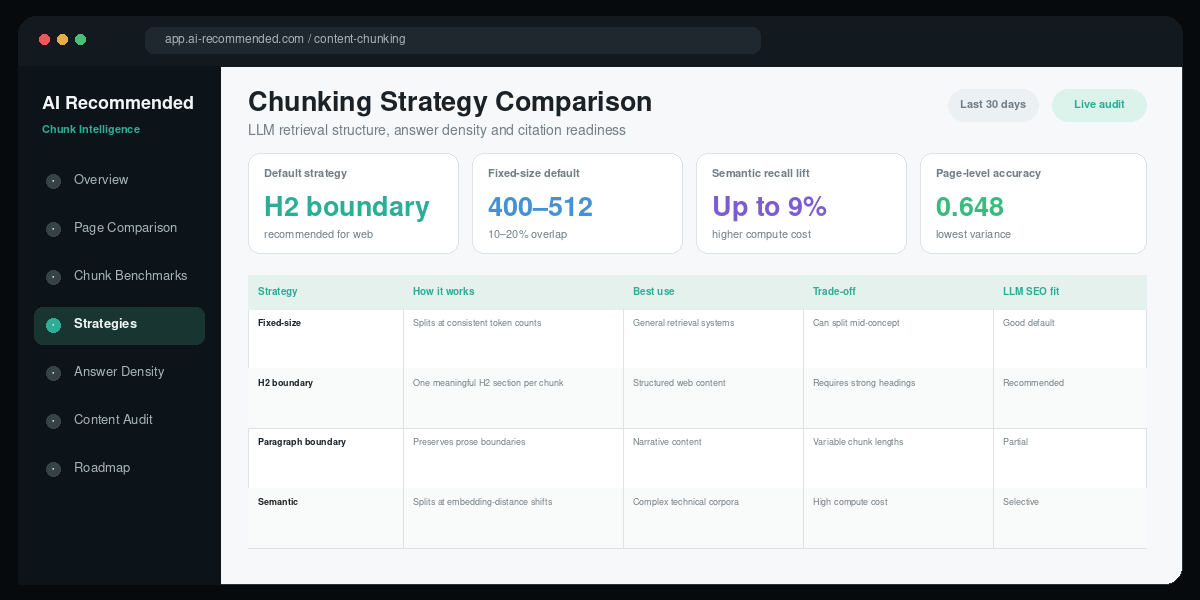
| Strategy | How It Works | Best Use | Trade-Off |
|---|---|---|---|
| Fixed-size chunking | Splits content at a consistent sentence, page, or token-length boundary, normally with a controlled overlap. | A predictable technical default for large, mixed document collections. | May split a sentence or concept at an unnatural point. |
| H2-boundary chunking | Treats each meaningful H2 section as one retrieval unit and preserves the heading as retrieval context. | Structured web pages and long-form educational articles. | Requires clear question-led headings and disciplined section scope. |
| Sentence or paragraph boundary | Splits at natural language boundaries to preserve readability. | Narrative or prose-heavy content with consistent paragraph structure. | Produces variable lengths and may combine unrelated concepts. |
| Semantic chunking | Detects meaningful topic boundaries and preserves semantic relationships across sentences and paragraphs. | Specialised technical corpora where topic transitions are difficult to detect structurally. | Higher processing cost and inconsistent gains for ordinary web pages. |
Related external perspectives include Semrush on content chunking, Ahrefs on semantic search, iPullRank on vector embeddings, and Neil Patel on answer-engine structure. These sources are useful for editorial implementation, while platform documentation should remain the source of truth for technical chunk-size limits and ingestion behaviour.
How Do Chunking Defaults Differ Across AI Platforms?
Direct answer: Major retrieval platforms do not use one universal chunk size. Google Agent Search, OpenAI vector stores, Azure AI Search, and Anthropic’s published Contextual Retrieval example use different defaults and methods because their parsers, retrieval stages, document types, and evaluation goals differ.
| Platform or Method | Published Setting | What the Setting Demonstrates | Website Content Lesson |
|---|---|---|---|
| Google Agent Search | 500-token default; configurable from 100 to 500 tokens | Layout-aware retrieval values coherent structural units and can carry headings into the chunk. | Use meaningful headings and keep one dominant intent inside each section. |
| OpenAI vector stores | 800-token maximum with 400-token overlap under the automatic strategy | Larger windows and substantial overlap can be valid when the system controls ingestion and retrieval. | Do not claim that every retrieval system uses 256–512-token boundaries. |
| Azure AI Search | Fixed, layout-aware, sentence/page, and semantic options | Document structure and downstream task should determine the split strategy. | Audit headings, paragraphs, tables, and semantic transitions—not word count alone. |
| Anthropic Contextual Retrieval | 800-token example plus 50–100 tokens of generated context | Adding concise document context can restore meaning lost when a passage is separated from its source. | Make each section identify its subject, category, and document context explicitly. |
Platform defaults are engineering configurations, not direct SEO ranking factors. Their value is explanatory: they show that retrieval systems segment content, preserve varying amounts of context, and evaluate passages independently. Website optimisation should therefore improve clarity and self-containment without pretending to control a proprietary crawler’s exact chunk boundary.
Why Do Headings and Inherited Context Matter?
Direct answer: A passage can become ambiguous when it is separated from its page title, parent heading, product name, date, or audience. Heading inheritance and explicit nouns restore the context required to interpret and rank the passage correctly.
Google’s Gemini layout parser creates context-aware chunks that can include ancestral headings and table headers. Google’s layout-parser configuration supports including up to two levels of ancestor headings. The implementation detail matters because a sentence such as “The limit is 500” is weak when extracted alone, while “Google Agent Search supports a chunk-size limit from 100 to 500 tokens” remains interpretable.
| Context Failure | Weak Extracted Passage | Self-Contained Revision |
|---|---|---|
| Missing entity | “It uses 800 tokens by default.” | “OpenAI vector stores currently use an 800-token maximum under the automatic chunking strategy.” |
| Missing parent question | “Yes, but only in some cases.” | “Chunk overlap is useful when facts or sentences may cross a boundary, but excessive overlap creates duplicate retrieval candidates.” |
| Missing comparison dimension | “The first option performs better.” | “Semantic chunking can preserve topic coherence better than fixed token splitting on structurally complex documents.” |
| Missing source and date | “Research found a 49% improvement.” | “Anthropic reported in 2024 that Contextual Embeddings combined with Contextual BM25 reduced failed top-20 retrievals by 49% in its evaluation.” |
Keep the page title and parent topic visible
The section should make clear whether it belongs to content chunking, vector retrieval, schema, crawling, or another layer. A repeated category noun is more useful than an ambiguous pronoun.
Write headings that state the evaluation intent
“How much overlap should chunks use?” gives the reader and retrieval system a specific decision frame. “Overlap” supplies much less context.
Preserve source labels inside evidence sentences
Include the organisation, measurement, and condition inside the same paragraph as the number. Do not rely on a footnote or a previous paragraph to establish what the statistic means.
Use explicit bridge sentences between subtopics
When a section moves from chunk size to overlap or from structure to citation, identify the transition. A bridge sentence prevents two distinct concepts from blending into one vague embedding direction.
How Much Chunk Overlap Should a Retrieval System Use?
Direct answer: Overlap protects information that crosses a boundary, but it should be tested rather than maximised. Too little overlap can separate a definition from its qualifier; too much overlap creates near-duplicate chunks, consumes storage and context, and can crowd diverse evidence out of the Top-K set.
OpenAI’s automatic vector-store strategy uses 400 tokens of overlap with an 800-token maximum chunk. Azure AI Search explains that overlapping windows can preserve continuity, while semantic and layout-aware approaches can reduce the need for arbitrary duplication by splitting at meaningful boundaries.
| Overlap Level | Potential Benefit | Potential Failure | When to Test It |
|---|---|---|---|
| No overlap | Lowest storage cost and minimal duplicate evidence. | A sentence, definition, or table explanation can be separated from the information it qualifies. | Short, clean FAQ entries or strongly self-contained H2 sections. |
| Small overlap | Preserves local continuity without reproducing most of the previous chunk. | May still miss relationships that span a long paragraph or table. | Structured articles with clear paragraph and heading boundaries. |
| Moderate overlap | Protects definitions, transitions, and evidence near boundaries. | Creates repeated passages that can compete with one another in retrieval. | Technical documents, policies, manuals, and narrative explanations. |
| High overlap | Maximises continuity across arbitrary fixed-size splits. | Increases index size, latency, token usage, and duplicate Top-K results. | Only when fixed splitting is unavoidable and evaluation shows boundary loss. |
Overlap inside a vendor’s vector store is not the same as repeating paragraphs on a public webpage. Do not duplicate visible copy to imitate a retrieval pipeline. Instead, make sections coherent, use descriptive headings, and let the indexing system apply its own overlap strategy.
How Should Tables, Lists, Images, and Boilerplate Be Chunked?
Direct answer: Complex elements should remain connected to the heading, caption, labels, and explanatory text that give them meaning. A table without headers, an image without an accurate caption, or a list detached from its introductory sentence becomes a weak retrieval unit.
Google Agent Search’s layout parser detects headings, lists, tables, images, and structural hierarchy. It can annotate tables and images so their meaning contributes to retrieval and answer generation. The same documentation also supports excluding HTML boilerplate such as navigation, headers, footers, sidebars, cookie banners, and overlays from parsing in configured data stores.
| Element | Chunking Risk | Implementation Requirement |
|---|---|---|
| Comparison table | Rows become meaningless when column headers are not preserved. | Use real table headers, specific cell values, a clear introductory sentence, and a caption that states what is being compared. |
| Numbered list | Individual steps can lose the process name, order, or expected outcome. | Name the process before the list and make every step contain an explicit action and object. |
| Image or dashboard | Critical evidence exists only as pixels and cannot be understood from nearby text. | Provide accurate alt text, a descriptive caption, and the important factual conclusion in visible HTML. |
| FAQ accordion | Answers are injected only after interaction or hidden from the initial HTML. | Keep the question and answer in accessible HTML and ensure structured data matches the visible content. |
| Navigation and sidebars | Repeated boilerplate pollutes the chunk with unrelated links and CTA language. | Use semantic page structure and, where the retrieval system permits it, exclude boilerplate elements from ingestion. |
| Code or configuration | A snippet loses the platform, version, variables, or explanation required to use it safely. | Introduce the platform and purpose before the code, then explain the expected result immediately after it. |
Google Document AI and Azure’s semantic chunking documentation both reinforce the same principle: structural context is part of the information. For website editors, this means captions, labels, headings, and table headers should not be treated as decorative extras.
What Is Answer Density and Why Does It Affect Citations?
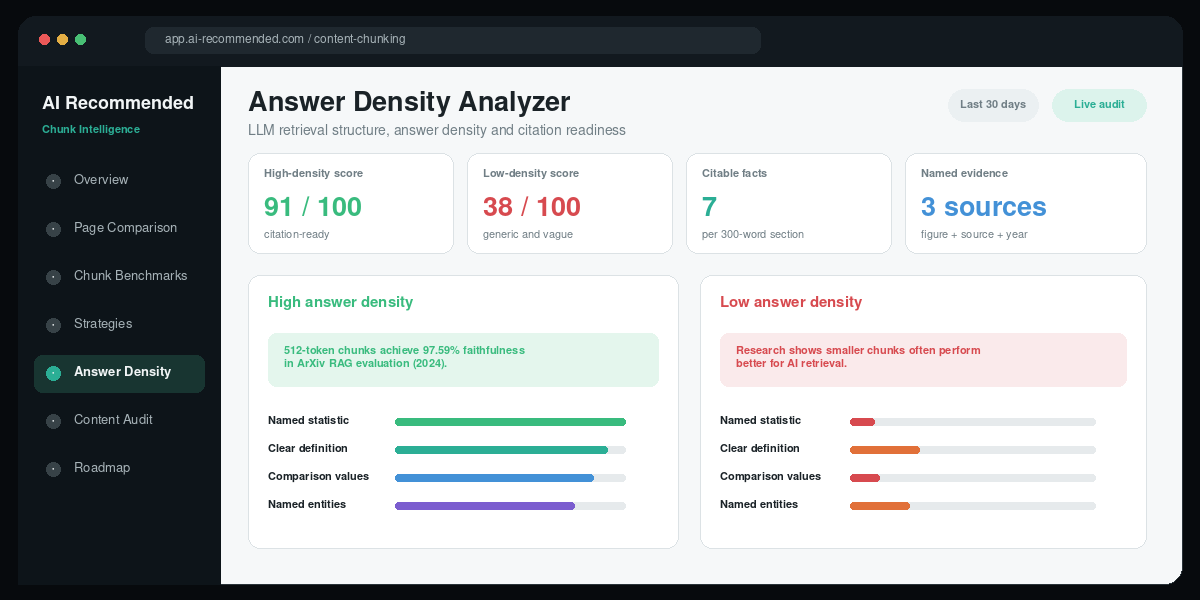
Direct answer: Answer density measures how much specific, verifiable, citation-worthy information a section contains relative to its length. Two sections can contain the same number of words while producing completely different retrieval and attribution value.
| High Answer Density | Low Answer Density | Retrieval Difference |
|---|---|---|
| “A published RAG evaluation reported 97.59% faithfulness at 512 tokens under its tested corpus, model, and query conditions.” | “Research shows that smaller chunks often work better.” | The first statement contains a specific, attributable fact that can support a citation. |
| Defines content chunking as independent H2 retrieval units scored against query vectors. | Defines chunking as “breaking content into chunks”. | The specific definition establishes mechanism, context, and named concepts. |
| Uses a table containing exact token sizes and faithfulness scores. | Says that “longer sections tend to perform worse”. | Each factual table row becomes a separate evaluation-intent retrieval candidate. |
Format-level implementation is covered in How Tables, Lists, and Definitions Help LLM Retrieval.
What Are the Six Requirements for a Citation-Ready Chunk?
A citation-ready section combines semantic alignment with independence, evidence, crawlability, and enough detail to contribute something distinctive after retrieval.
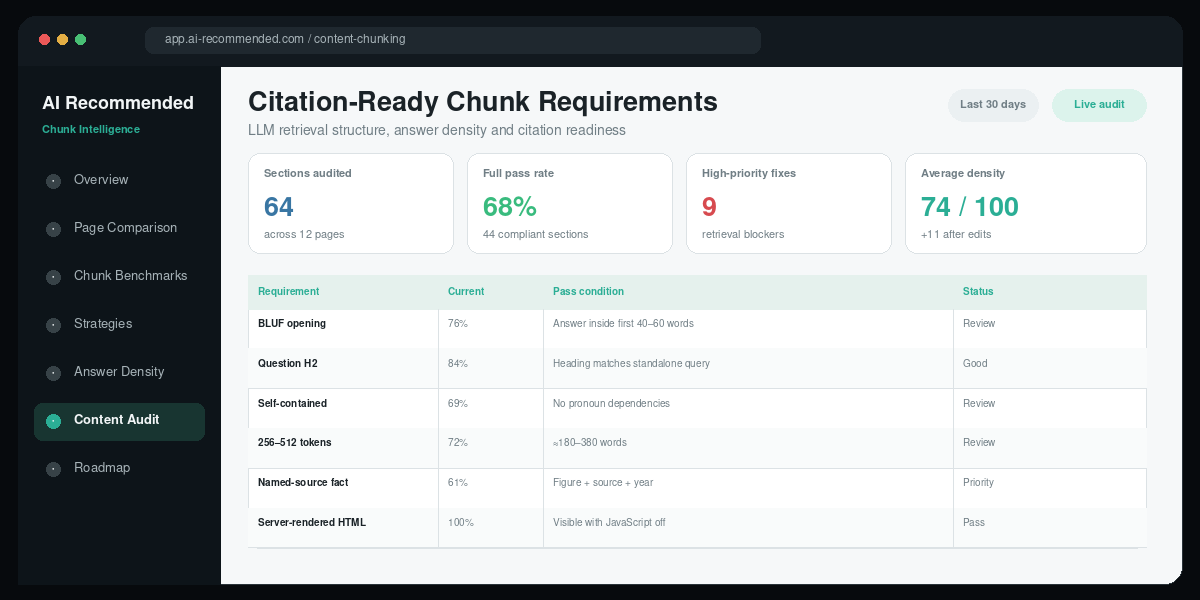
Open with a 40–60 word BLUF answer
The first paragraph should answer the heading completely. Supporting explanation, evidence, exceptions, and examples follow after the answer is already clear.
Use a question-phrased H2 heading
The heading acts as a contextual prefix. “What is the optimal chunk size for LLM retrieval?” provides more retrieval context than “Chunk Size”. Google’s ancestor-heading option illustrates why retaining heading context can reduce ambiguity after extraction.
Remove every pronoun dependency
Replace “this method”, “as discussed earlier”, and “the format above” with explicit noun references that remain meaningful when the section is extracted.
Target approximately 256–512 tokens
Keep most important H2 sections within approximately 180–380 words, provided that range allows the question to be answered naturally and completely.
Add at least one named-source fact
Include a figure, named source, year, and measurement context in the same sentence so the evidence remains attributable after extraction.
Serve the section in visible HTML
Verify that every heading and paragraph remains available in rendered HTML. Google’s JavaScript SEO documentation explains how rendering affects discovery, while Google’s AI features guidance confirms that standard Search eligibility and quality practices remain relevant to AI Overviews and AI Mode.
Content Chunking Audit Checklist
Use this checklist on the pages that generate the most commercial traffic, explain the company’s main services, or target the questions buyers are most likely to ask AI systems.
| # | What to Check | Pass Condition |
|---|---|---|
| 1 | H2 headings are written as the exact question answered by the section. | Every heading makes sense as a standalone buyer query. |
| 2 | The direct answer appears inside the first 40–60 words. | Reading only the first paragraph answers the heading completely. |
| 3 | No key section depends on a previous paragraph or heading. | The section makes complete sense when copied into a separate document. |
| 4 | H2 sections generally remain between 180 and 380 words. | No section mixes several intents or lacks necessary explanation. |
| 5 | Every key section contains at least one named-source statistic. | Figure, source, year, and context appear in the same sentence. |
| 6 | Comparison tables contain specific factual cell values. | No vague relative descriptors remain in important comparison cells. |
| 7 | All important content is visible with JavaScript disabled. | Headings, answers, evidence, and tables remain present in server-delivered HTML. |
| 8 | AI crawler access is confirmed through server logs. | Relevant crawlers receive successful responses on priority URLs. |
| 9 | Genuine FAQ questions use visible answers and valid FAQPage schema. | Every structured question and answer matches what users can see on the page. |
Common failures are explained in Content Chunking Mistakes That Hurt LLM Visibility.
What Is the Three-Step Content Chunking Audit?
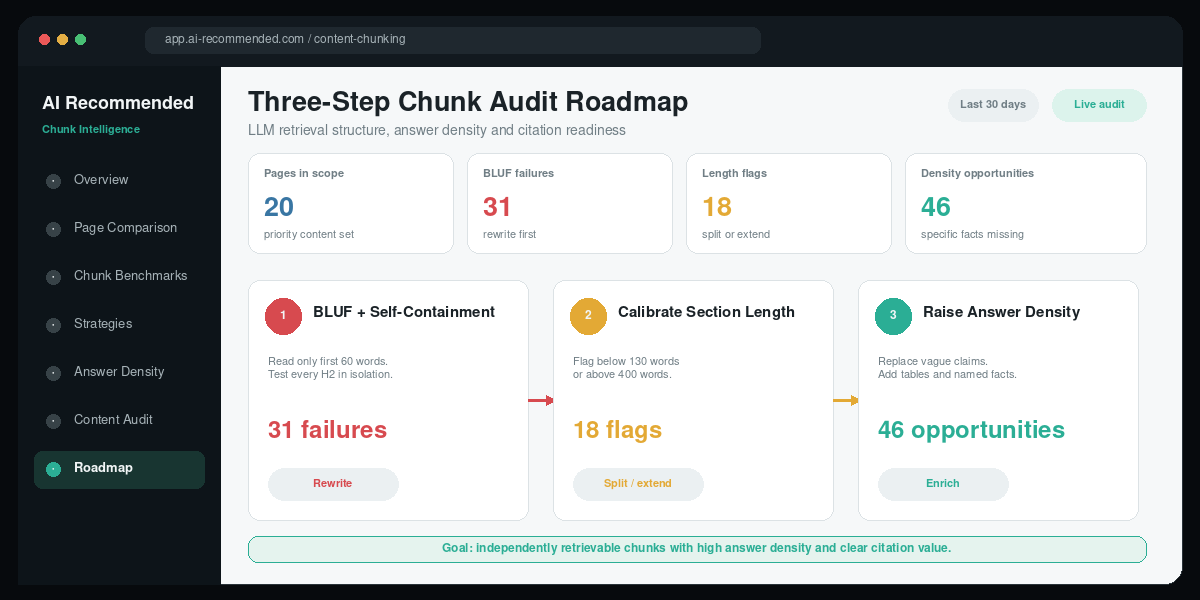
The audit begins with answer placement and independence, then checks section length, and finishes by increasing the amount of distinctive, attributable information inside every priority section.
Run the BLUF and self-containment tests
Read only the first 60 words of every H2 section. Mark sections where the answer is missing. Then read each section independently and mark every unclear pronoun or missing contextual reference.
Calibrate section length
Flag sections below 130 words and above 400 words. Split oversized sections where the topic changes. Expand short sections only when evidence or explanation is genuinely missing.
Raise answer density
Replace vague claims with named evidence, convert evaluative prose into factual tables, add explicit definitions, and use genuine FAQ blocks to expand the page’s retrieval surface.
Do not restructure content merely to manufacture short sections. Restructure it so every important question has one clear, complete, independently useful answer.
Content chunking implementation principleHow Do You Test Whether a Chunking Strategy Actually Works?
Direct answer: Test chunking with a fixed set of real questions, known relevant passages, and retrieval metrics before judging generated answers. A visually tidy page can still retrieve poorly, and a different chunk size may perform better for definitions, comparisons, troubleshooting, and multi-step questions.
Create a representative query set
Collect buyer questions, support questions, comparison prompts, entity lookups, and multi-step queries. Include easy exact-match questions and harder paraphrased questions so the test measures both lexical and semantic retrieval.
Label the expected evidence
For each query, record the page, H2 section, table row, or paragraph that contains the correct answer. This ground-truth set makes it possible to distinguish retrieval failure from generation failure.
Compare several chunk configurations
Test section boundaries, fixed sizes, semantic splitting, different overlaps, inherited headings, and metadata filters. Keep the embedding model and query set constant while changing one variable at a time.
Measure retrieval before generation
Track whether the expected passage appears in the Top-K set, its rank, duplicate-chunk rate, and the amount of irrelevant context retrieved. Microsoft’s RAG guidance separates content preparation, retrieval quality, and answer formulation for the same reason.
Evaluate the final answer and citation
After retrieval passes, test whether the model uses the correct evidence, preserves qualifiers, cites the right source, and avoids combining conflicting chunks. Generation quality cannot repair a passage that never reached the context window.
| Metric | What It Reveals | Failure Example |
|---|---|---|
| Recall@K | Whether the expected evidence appears anywhere in the first K retrieved chunks. | The correct section is absent from the candidate set. |
| Mean reciprocal rank | How early the first correct chunk appears. | Relevant evidence appears at rank nine when the system only sends five chunks to the model. |
| Duplicate-chunk rate | Whether overlap or repeated boilerplate is crowding out diverse evidence. | Four of five results repeat nearly identical paragraphs. |
| Context precision | How much retrieved material is relevant to the question. | A broad section contains the answer but adds several unrelated subtopics. |
| Answer faithfulness | Whether the generated claim is supported by the retrieved passages. | The model invents a universal rule from one platform-specific default. |
| Citation correctness | Whether the attributed source actually supports the claim. | The answer links to the right page but the cited passage does not contain the stated number. |
Chunk-size advice becomes reliable only after it survives retrieval testing on the questions, documents, and models that matter to the actual application.
Evidence-led chunking principleHow Should Content Chunking Performance Be Measured?
Publishing more sections is not the objective. Measurement should show whether priority sections are becoming easier to retrieve, more useful during synthesis, and more likely to receive explicit attribution.
Frequently Asked Questions
What is a content chunk in LLM SEO?
What is the optimal content chunk size for AI retrieval?
Does Google require rigid content chunking?
What is answer density?
Why are question-led H2 headings useful?
When should a long H2 section be split?
Do all AI platforms use 256–512-token chunks?
Should a website repeat content to create chunk overlap?
Why can ancestor headings improve retrieval?
Key Takeaways
- Content chunking creates independent retrieval and citation candidates within a page.
- Approximately 256–512 tokens is a useful starting range for focused web sections, but platform defaults and dataset optima vary.
- Every important section should begin with a direct 40–60 word answer.
- Question-led headings act as contextual prefixes for readers and retrieval systems.
- Self-contained sections avoid pronouns and references that depend on earlier content.
- Answer density determines how much distinctive, citable information survives the synthesis stage.
- Headings, ancestor context, captions, table headers, and explicit nouns protect meaning when a passage is extracted.
- Overlap belongs in the retrieval pipeline; visible webpage copy should not be duplicated to imitate it.
- Technical visibility is essential because content that cannot be crawled cannot be embedded or retrieved.
- Good structure should improve usefulness for humans as well as AI systems.

About the Author
Marcus Hibbert is the founder of AI Recommended, a leading Generative Engine Optimisation (GEO) agency helping UK B2B technology companies become the trusted recommendation across ChatGPT, Google AI Mode, AI Overviews, Gemini, Claude, Perplexity and Microsoft Copilot whenever decision-makers search for products, services and solutions.
Connect with Marcus on LinkedIn.
Request an LLMO Audit
Discover how AI platforms describe, cite and recommend your brand across the prompts your ideal buyers use—and uncover opportunities to become AI's trusted recommendation.
By submitting this form, you’re requesting a Large Language Model Optimization (LLMO) audit for your brand.

.png)