


Content Chunking for LLM SEO
How to structure pages for better AI retrieval — including the 256–512 token evidence, four chunking strategies, answer density, six structural requirements, and the audit that identifies sections limiting AI visibility.
When an LLM answers a question, it does not necessarily evaluate an article as one uninterrupted document. Retrieval systems identify individual passages, score them independently, and pass only the strongest candidates into the final answer-generation stage.
A page with six focused, self-contained H2 sections can create six strong retrieval candidates. A page containing the same information inside one long section may create only one diluted candidate.
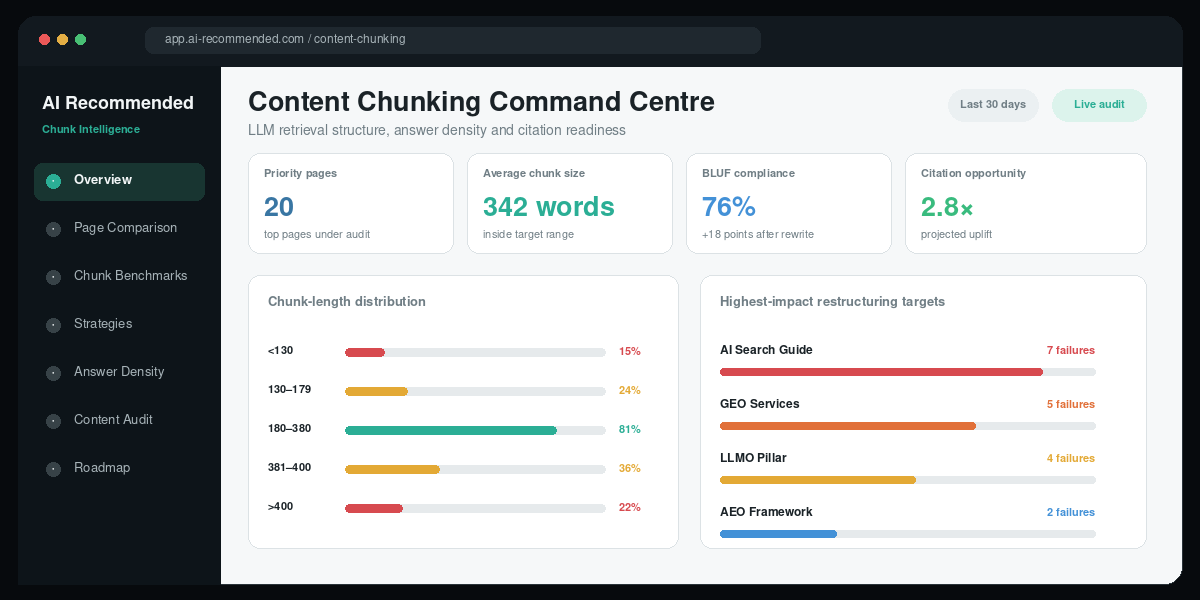
What Do the Content Chunking Numbers Show?
The evidence points to a practical middle range: enough space to answer one meaningful question completely, but not enough space for multiple unrelated concepts to dilute the section’s semantic focus.
What Is Content Chunking in LLM SEO?
Direct answer: Content chunking is the deliberate organisation of a page into logical, self-contained sections that AI systems can independently crawl, embed, retrieve, understand, and cite.
In practical web content, an H2 heading and its supporting paragraphs often act as a natural chunk boundary. The heading provides the contextual label, while the section body supplies the direct answer, evidence, and detail.
Poor chunking creates a retrievability gap. The page may contain the correct information, but the answer is buried inside background, mixed with unrelated topics, dependent on an earlier paragraph, or unavailable to AI crawlers.
Read the foundational sub-article: What Is Content Chunking in LLM SEO?
What Is the Difference Between Poor and Effective Chunking?
The information may be identical, but the structure changes how easily a retrieval system can isolate the answer, understand its subject, and use it without the surrounding page.
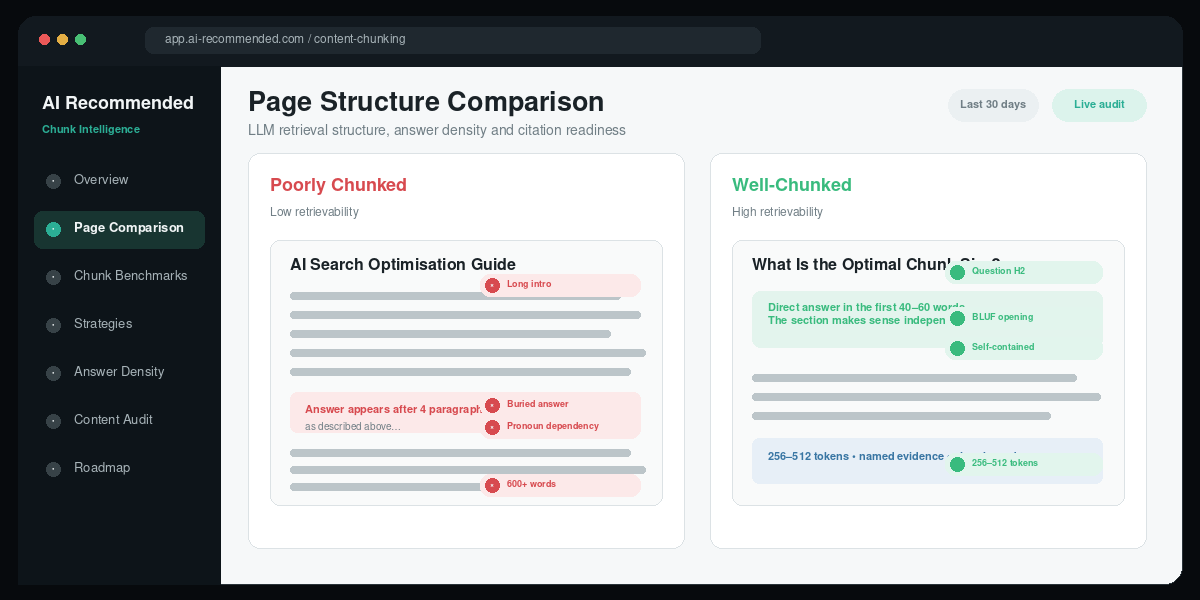
| Poorly Chunked Content | Well-Chunked Content |
|---|---|
| Long introduction before the section answers its heading. | Direct answer appears inside the first 40–60 words. |
| One section continues for more than 600 words and covers several intents. | One H2 section resolves one distinct question in approximately 180–380 words. |
| Uses phrases such as “as mentioned above” or “this approach”. | Uses explicit nouns so the section makes sense independently. |
| Contains dense background prose with few specific facts. | Uses definitions, named evidence, factual tables, and actionable steps. |
| Has no clear semantic boundary before the next topic begins. | Closes the current answer before introducing the next question-led H2. |
A practical answer-block workflow is available in How to Create Self-Contained Answer Blocks for LLMs.
What Is the Optimal Content Chunk Size for AI Retrieval?
Direct answer: The strongest working range is approximately 256–512 tokens, which usually translates to roughly 180–380 words per H2 section. Shorter sections may lack context, while much longer sections risk combining several intents and weakening semantic precision.
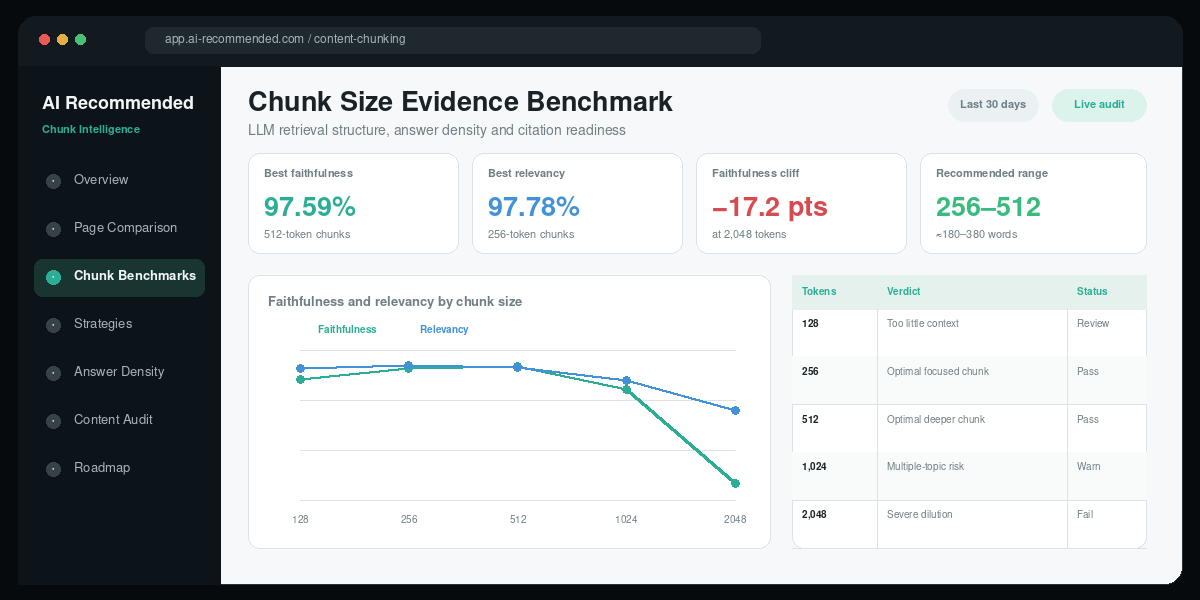
| Chunk Size | Approx. Words | Faithfulness | Relevancy | Practical Verdict |
|---|---|---|---|---|
| 128 tokens | About 95 words | 95.74% | 97.22% | Useful for simple facts, but often too short for complex answers. |
| 256 tokens | About 190 words | 97.22% | 97.78% | Optimal for focused, single-concept sections. |
| 512 tokens | About 380 words | 97.59% | 97.41% | Optimal when the question requires greater explanation depth. |
| 1,024 tokens | About 760 words | 94.26% | 95.56% | Likely to combine several topics and dilute the embedding. |
| 2,048 tokens | About 1,530 words | 80.37% | 91.11% | Poor retrieval performance and severe semantic dilution. |
The recommended range is a diagnostic guide, not a reason to pad short answers or split a coherent explanation artificially. Semantic completeness and answer density remain more important than hitting an exact word count.
Paragraph-level guidance is covered in Ideal Paragraph Length for LLM SEO.
Which Content Chunking Strategy Should a Website Use?
Question-led H2 boundary chunking is the strongest default for structured web articles because it preserves semantic meaning and gives every section a natural contextual prefix.
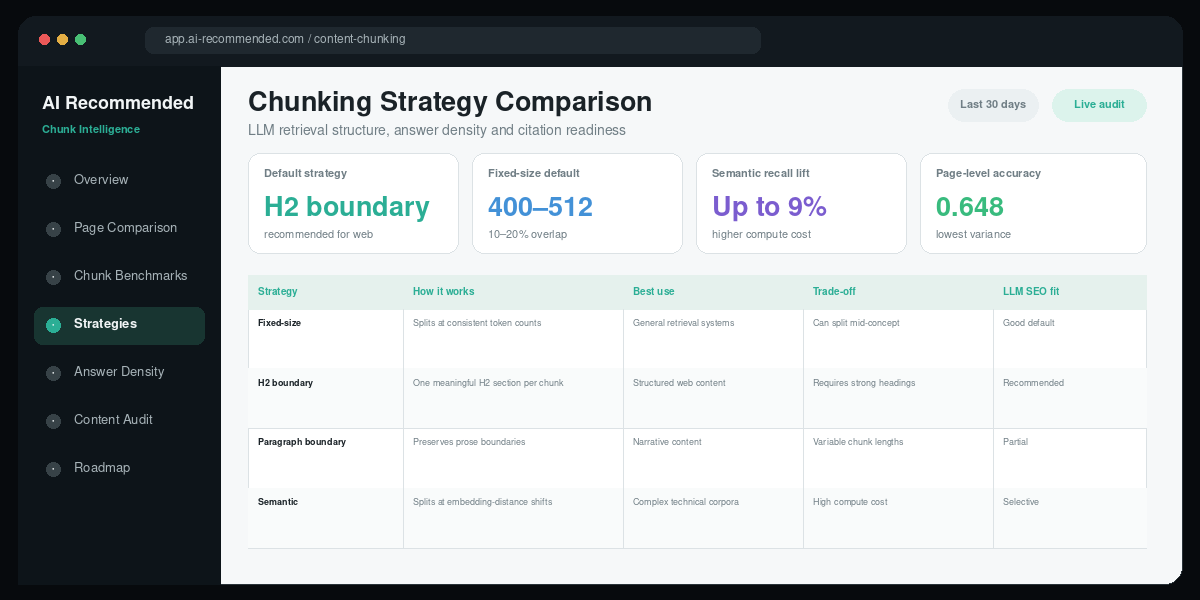
| Strategy | How It Works | Best Use | Trade-Off |
|---|---|---|---|
| Fixed-size chunking | Splits content at a consistent token count, normally with a small overlap. | A predictable technical default for large, mixed document collections. | May split a sentence or concept at an unnatural point. |
| H2-boundary chunking | Treats each meaningful H2 section as one retrieval unit. | Structured web pages and long-form educational articles. | Requires clear question-led headings and disciplined section scope. |
| Sentence or paragraph boundary | Splits at natural language boundaries to preserve readability. | Narrative or prose-heavy content with consistent paragraph structure. | Produces variable lengths and may combine unrelated concepts. |
| Semantic chunking | Detects topic changes by comparing embedding distance between adjacent sentences. | Specialised technical corpora where topic transitions are difficult to detect structurally. | Higher processing cost and inconsistent gains for ordinary web pages. |
Related external perspectives: Semrush on content chunking, Ahrefs on chunk optimisation, iPullRank on vector embeddings, and Neil Patel on answer-engine structure.
What Is Answer Density and Why Does It Affect Citations?
Direct answer: Answer density measures how much specific, verifiable, citation-worthy information a section contains relative to its length. Two sections can contain the same number of words while producing completely different retrieval and attribution value.
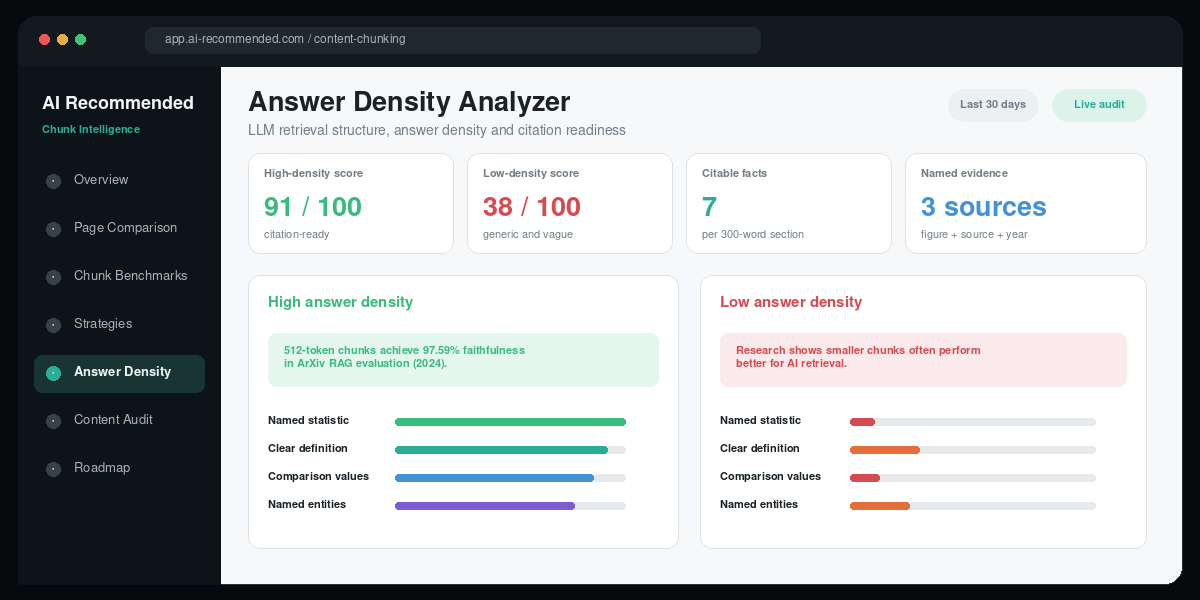
| High Answer Density | Low Answer Density | Retrieval Difference |
|---|---|---|
| “512-token chunks achieved 97.59% faithfulness in the cited ArXiv RAG evaluation.” | “Research shows that smaller chunks often work better.” | The first statement contains a specific, attributable fact that can support a citation. |
| Defines content chunking as independent H2 retrieval units scored against query vectors. | Defines chunking as “breaking content into chunks”. | The specific definition establishes mechanism, context, and named concepts. |
| Uses a table containing exact token sizes and faithfulness scores. | Says that “longer sections tend to perform worse”. | Each factual table row becomes a separate evaluation-intent retrieval candidate. |
Format-level implementation is covered in How Tables, Lists, and Definitions Help LLM Retrieval.
What Are the Six Requirements for a Citation-Ready Chunk?
A citation-ready section combines semantic alignment with independence, evidence, crawlability, and enough detail to contribute something distinctive after retrieval.
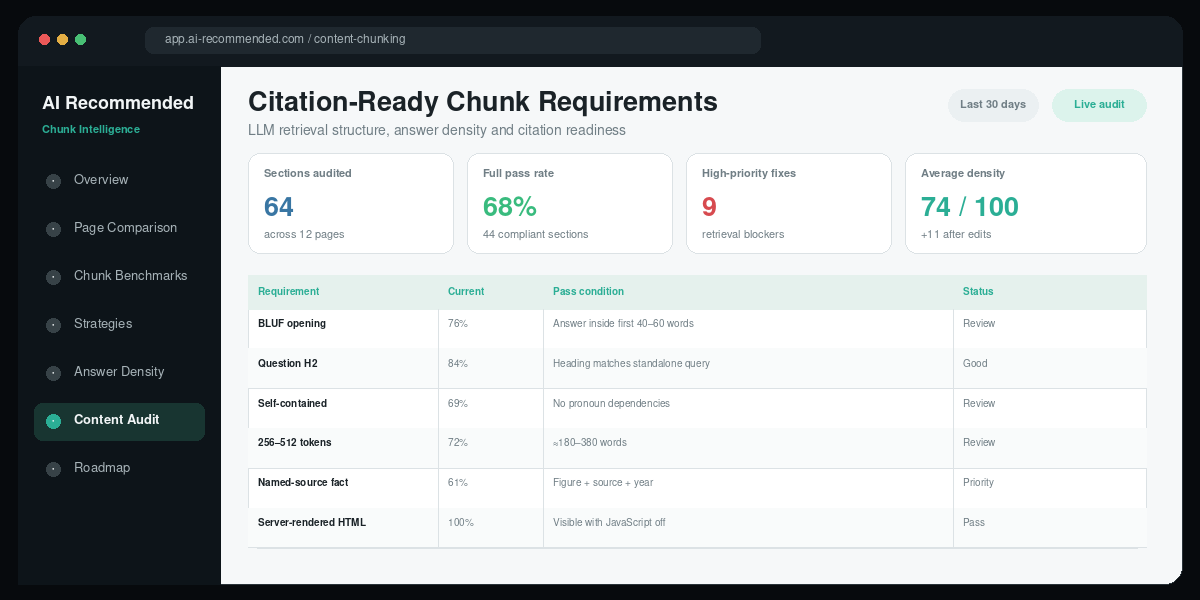
Open with a 40–60 word BLUF answer
The first paragraph should answer the heading completely. Supporting explanation, evidence, exceptions, and examples follow after the answer is already clear.
Use a question-phrased H2 heading
The heading acts as a contextual prefix. “What is the optimal chunk size for LLM retrieval?” provides more retrieval context than “Chunk Size”.
Remove every pronoun dependency
Replace “this method”, “as discussed earlier”, and “the format above” with explicit noun references that remain meaningful when the section is extracted.
Target approximately 256–512 tokens
Keep most important H2 sections within approximately 180–380 words, provided that range allows the question to be answered naturally and completely.
Add at least one named-source fact
Include a figure, named source, year, and measurement context in the same sentence so the evidence remains attributable after extraction.
Serve the section in visible HTML
Verify that every heading and paragraph remains visible when JavaScript is disabled and that relevant AI crawlers receive successful page responses.
Content Chunking Audit Checklist
Use this checklist on the pages that generate the most commercial traffic, explain the company’s main services, or target the questions buyers are most likely to ask AI systems.
| # | What to Check | Pass Condition |
|---|---|---|
| 1 | H2 headings are written as the exact question answered by the section. | Every heading makes sense as a standalone buyer query. |
| 2 | The direct answer appears inside the first 40–60 words. | Reading only the first paragraph answers the heading completely. |
| 3 | No key section depends on a previous paragraph or heading. | The section makes complete sense when copied into a separate document. |
| 4 | H2 sections generally remain between 180 and 380 words. | No section mixes several intents or lacks necessary explanation. |
| 5 | Every key section contains at least one named-source statistic. | Figure, source, year, and context appear in the same sentence. |
| 6 | Comparison tables contain specific factual cell values. | No vague relative descriptors remain in important comparison cells. |
| 7 | All important content is visible with JavaScript disabled. | Headings, answers, evidence, and tables remain present in server-delivered HTML. |
| 8 | AI crawler access is confirmed through server logs. | Relevant crawlers receive successful responses on priority URLs. |
| 9 | Genuine FAQ questions use visible answers and valid FAQPage schema. | Every structured question and answer matches what users can see on the page. |
Common failures are explained in Content Chunking Mistakes That Hurt LLM Visibility.
What Is the Three-Step Content Chunking Audit?
The audit begins with answer placement and independence, then checks section length, and finishes by increasing the amount of distinctive, attributable information inside every priority section.
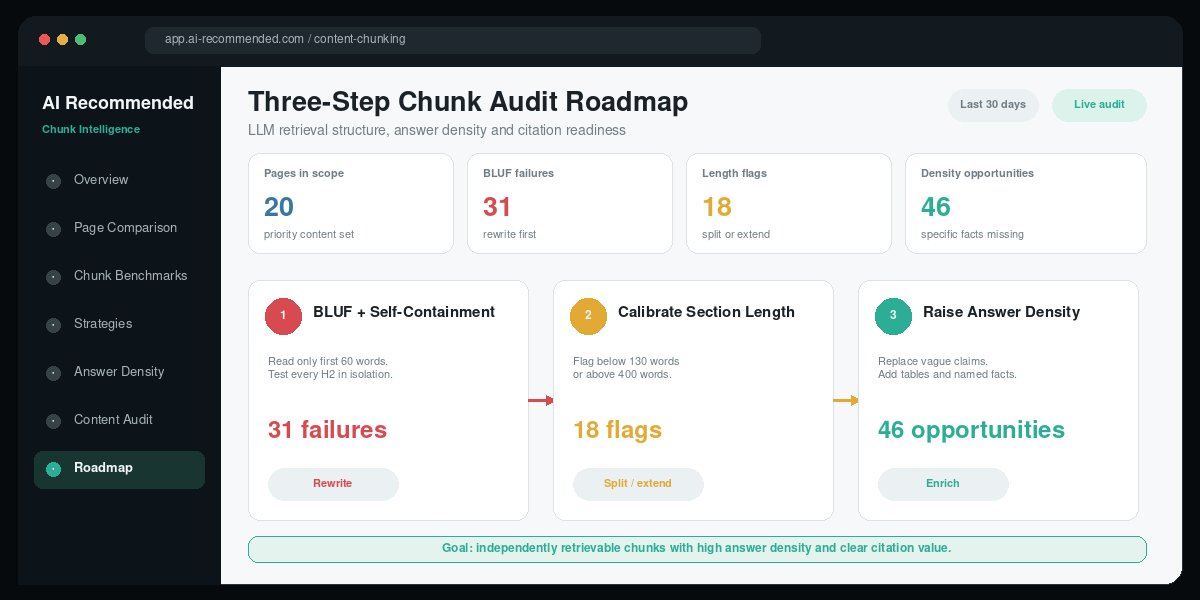
Run the BLUF and self-containment tests
Read only the first 60 words of every H2 section. Mark sections where the answer is missing. Then read each section independently and mark every unclear pronoun or missing contextual reference.
Calibrate section length
Flag sections below 130 words and above 400 words. Split oversized sections where the topic changes. Expand short sections only when evidence or explanation is genuinely missing.
Raise answer density
Replace vague claims with named evidence, convert evaluative prose into factual tables, add explicit definitions, and use genuine FAQ blocks to expand the page’s retrieval surface.
Do not restructure content merely to manufacture short sections. Restructure it so every important question has one clear, complete, independently useful answer.
Content chunking implementation principleHow Should Content Chunking Performance Be Measured?
Publishing more sections is not the objective. Measurement should show whether priority sections are becoming easier to retrieve, more useful during synthesis, and more likely to receive explicit attribution.
Frequently Asked Questions
What is a content chunk in LLM SEO?
What is the optimal content chunk size for AI retrieval?
Does Google require rigid content chunking?
What is answer density?
Why are question-led H2 headings useful?
When should a long H2 section be split?
Key Takeaways
- Content chunking creates independent retrieval and citation candidates within a page.
- The strongest practical range is approximately 256–512 tokens or 180–380 words per H2 section.
- Every important section should begin with a direct 40–60 word answer.
- Question-led headings act as contextual prefixes for readers and retrieval systems.
- Self-contained sections avoid pronouns and references that depend on earlier content.
- Answer density determines how much distinctive, citable information survives the synthesis stage.
- Technical visibility is essential because content that cannot be crawled cannot be embedded or retrieved.
- Good structure should improve usefulness for humans as well as AI systems.

About the Author
Marcus Hibbert is the founder of AI Recommended. His work focuses on LLM Optimization, content chunking for AI retrieval, vector-search strategy, answer density, and AI citation measurement across ChatGPT, Perplexity, Gemini, Copilot, and Google AI.
Connect with Marcus on LinkedIn.
Request an LLMO Audit
Tell us which content pages matter most. We’ll run the BLUF test, self-containment test, section-length review, answer-density assessment, and technical-access audit across your priority pages.
By submitting this form, you are requesting a content-structure, retrieval, answer-density, crawler-access, and AI citation review.
