.svg)
.svg)

Embeddings and Vector Search Optimization: How LLMs Retrieve Relevant Content
How LLMs retrieve, rank, rerank, and use relevant content — from embeddings and vector indexes to hybrid search, metadata, chunk design, and the Top-K retrieval gate.
When a user asks an AI system a question, the system may search a vector index, a lexical index, a knowledge base, or several sources together. The query and candidate passages are represented numerically, compared for relevance, filtered, ranked, and often reranked before a limited set of passages reaches the language model. Google Cloud’s RAG reference architectures and OpenAI’s vector-store documentation show how retrieval infrastructure separates content ingestion from query-time search.
Content must clear several gates: it has to be crawlable or ingestible, divided into useful chunks, embedded into the correct index, matched to the query, survive metadata filters, reach the candidate set, and remain relevant after reranking. A failure at any one gate can make an otherwise excellent page unavailable to the answer-generation stage.
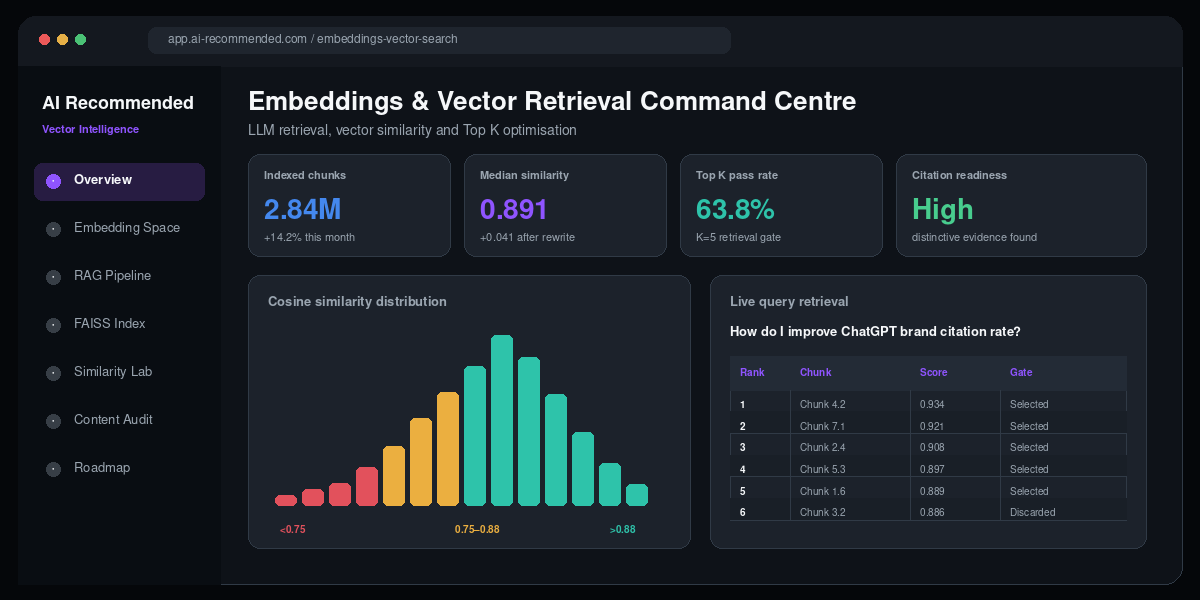
What Does a Vector Retrieval System Actually Optimise?
Direct answer: A vector retrieval system optimises the probability that the most useful passages appear inside a limited candidate set quickly enough for the application to respond. It is not directly optimising prose quality, brand authority, conversion rate, or factual accuracy. Microsoft’s vector-search overview describes the core workflow as indexing numeric representations and retrieving the vectors most similar to a query vector, while Google’s candidate-generation guidance explains why large collections are first reduced to a manageable group of likely matches.
For LLM SEO, the practical implication is simple: a page is not retrieved as one indivisible object. Its sections may be split, stored, filtered, and ranked independently. iPullRank’s vector-embedding analysis connects this retrieval model to AI-search content strategy, while Semrush’s semantic-search guide, Ahrefs’ topic-first analysis, and Neil Patel’s semantic-search overview explain why meaning and intent extend beyond literal keyword matching.
What Is an Embedding and Why Does It Matter?
Direct answer: An embedding is a numerical representation of text in high-dimensional space. Google’s embeddings guidance explains how dense vector representations capture semantic relationships. Semantically similar sentences, sections, and queries produce vectors pointing in similar directions. Retrieval systems compare those directions to identify content that addresses the same meaning, even when the wording is not identical.
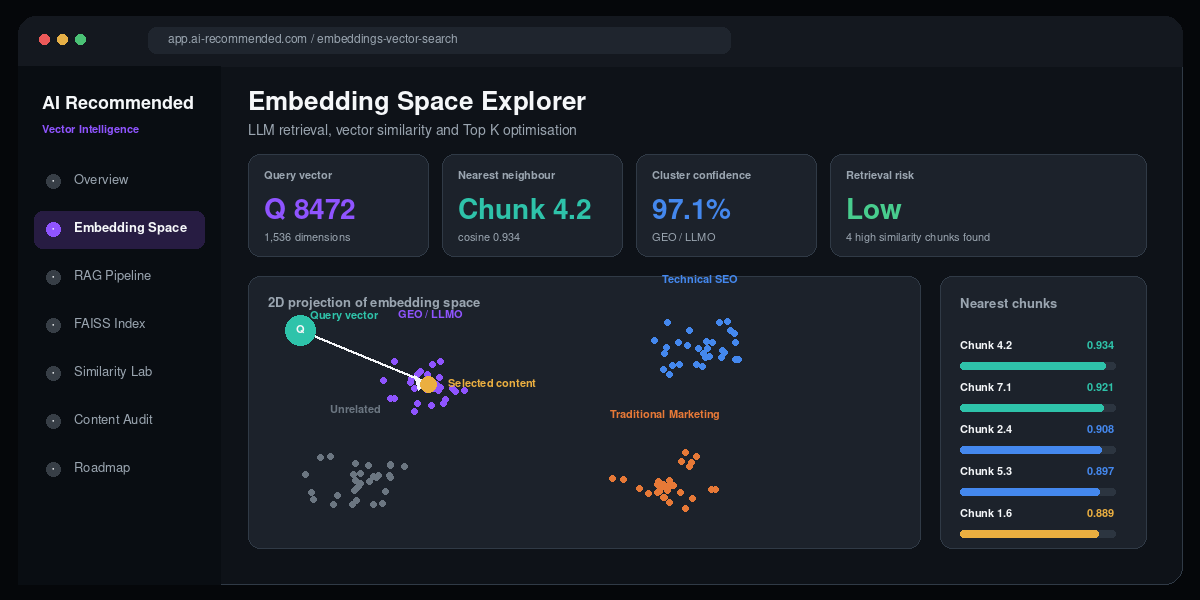
| Embedding Concept | What It Means | Content Implication |
|---|---|---|
| Text vector | A fixed-length list of floating-point values representing the meaning of a text fragment. | Each H2 section can become an independent retrievable unit. |
| Vector direction | The semantic orientation of the content in embedding space. | Use the language and entities present in real buyer queries. |
| Vector proximity | How close the content meaning is to the query meaning. | Tightly scoped sections normally align more precisely than broad multi-topic passages. |
| Query embedding | The user question converted into the same vector space as indexed content. | The query vocabulary defines the target semantic direction. |
For the foundational explanation, read What Are Embeddings in LLM SEO?. The wider strategy connects to the LLM Optimization pillar, while iPullRank’s vector-embedding guide provides additional industry context.
How Does a User Question Become a Searchable Vector?
Direct answer: The retrieval application sends the user’s question to an embedding model, which converts the text into a fixed-length vector in the same representational space used for the indexed passages. The search engine then compares the query vector with stored content vectors. Google’s embeddings module explains how dense representations capture relationships that sparse one-hot representations cannot express efficiently, and OpenAI’s embeddings API reference documents the query-to-vector interface used in retrieval applications.
| Query Stage | What the System Does | Why It Matters for Content |
|---|---|---|
| Question normalisation | The application may remove interface noise, preserve key entities, detect language, and identify filters such as geography, date, product, or audience. | Pages should use stable names for products, organisations, locations, standards, and roles so query filters can connect to reliable metadata. |
| Query rewriting | An orchestration model may expand one broad prompt into several narrower searches or rewrite a conversational question into a retrieval-friendly form. | Cover natural sub-questions, synonyms, abbreviations, category terms, and decision criteria instead of repeating one head keyword. |
| Query embedding | The rewritten or original query is converted into a vector using the same embedding family as the indexed passages. | Clear sections with one dominant intent produce a more coherent comparison target than passages that mix several unrelated answers. |
| Filter construction | Structured constraints may exclude content outside a date range, language, permission level, region, product family, or document type. | Correct titles, publication dates, language signals, categories, and structured metadata can determine whether the passage is considered at all. |
| Multi-query retrieval | Several query variants can run against the same index, and their result sets can be merged before reranking. | A complete cluster can win through several related semantic routes instead of relying on a single exact phrase. |
Query rewriting means the literal user prompt is not always the exact string used for retrieval. iPullRank’s RAG analysis describes the importance of intermediate retrieval steps, while the How Large Language Models Understand Content cluster explains how tokens, context windows, topic identification, and content structure affect the processing layer before and after retrieval.
How Does the End-to-End RAG Retrieval Pipeline Work?
Direct answer: The standard retrieval-augmented generation pipeline chunks accessible content, converts each chunk into an embedding, stores those vectors in a search index, embeds the user query, calculates similarity, returns the Top-K chunks, and passes only those chunks to the LLM for answer synthesis.
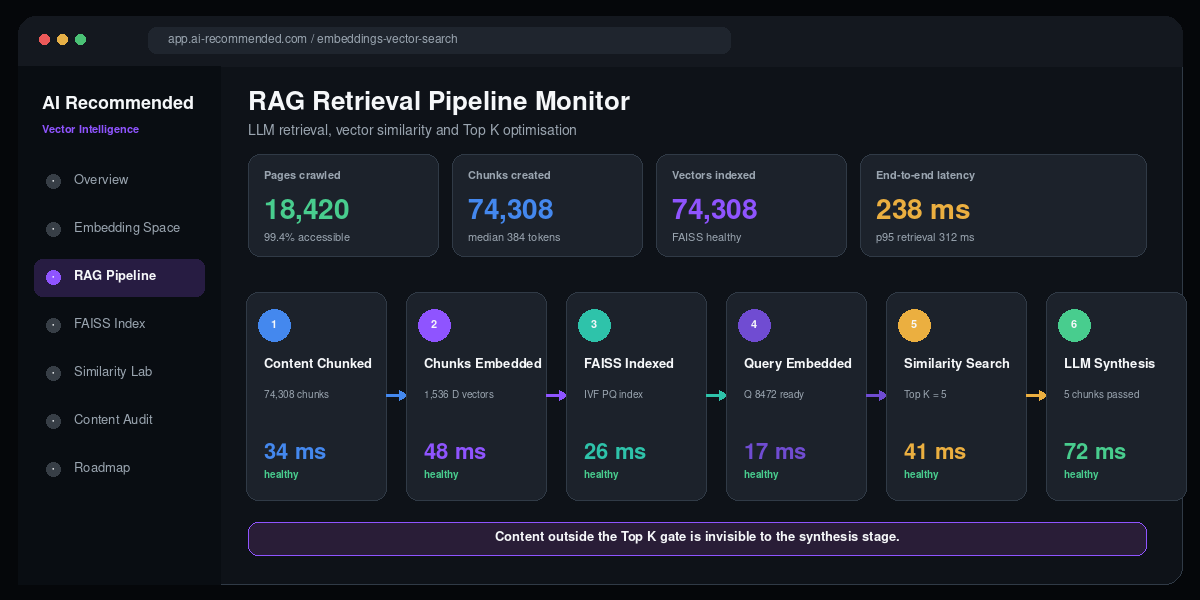
| Pipeline Step | What Happens | Optimization Implication |
|---|---|---|
| 1. Content chunking | Pages are divided into sections, often around H2 boundaries and a defined token range. | One focused page section can become one independent retrieval candidate. |
| 2. Chunk embedding | Each section is converted into a numerical vector by an embedding model. | Focused vocabulary and a single dominant topic produce a clearer semantic direction. |
| 3. Vector indexing | Chunk vectors are stored in a FAISS or comparable approximate-nearest-neighbour index. | Content must be crawlable and visible in server-delivered HTML before it can be indexed. Google’s JavaScript SEO guidance explains why rendered content and crawl access must be verified. |
| 4. Query embedding | The user question is converted into the same vector space as the content chunks. | Use the same terminology and specific entities that buyers use in prompts. |
| 5. Similarity search | The index ranks candidate chunks by cosine similarity or a related score and returns the Top-K. Candidate-generation systems similarly retrieve nearby embeddings using a similarity function. | The primary retrieval objective is to reach the limited candidate set. |
| 6. LLM synthesis | The retrieved chunks are used as context for the generated answer. | Distinctive data, named evidence, and precise claims increase the likelihood of attribution. |
What Is Approximate Nearest-Neighbour Search?
Direct answer: Approximate nearest-neighbour search, usually shortened to ANN, finds vectors that are very close to the query without exhaustively comparing the query with every stored vector. The goal is to maintain high recall while reducing latency and compute cost. Azure AI Search documentation describes nearest-neighbour indexing as the mechanism that places similar vectors close together, while FAISS provides multiple index structures for efficient dense-vector search.
Do not interpret a missing citation as proof that the page was judged low quality. The relevant passage may have been absent from the index, excluded by a filter, missed by approximate search, ranked just outside the candidate limit, or replaced by a stronger passage during reranking.
From a publishing perspective, ANN makes retrieval competitive. Your passage is not only compared with pages using the same keyword; it competes with semantically nearby chunks across the indexed corpus. That is why semantic completeness, topical authority, entity specificity, and useful evidence can matter together rather than as isolated optimisation tactics.
What Is FAISS and Why Does It Matter?
FAISS is a library for efficient similarity search and clustering of dense vectors, designed to perform nearest-neighbour search across very large collections of embeddings. Instead of comparing a query with every vector through expensive exact search, the index finds highly similar candidates quickly enough for production response times.
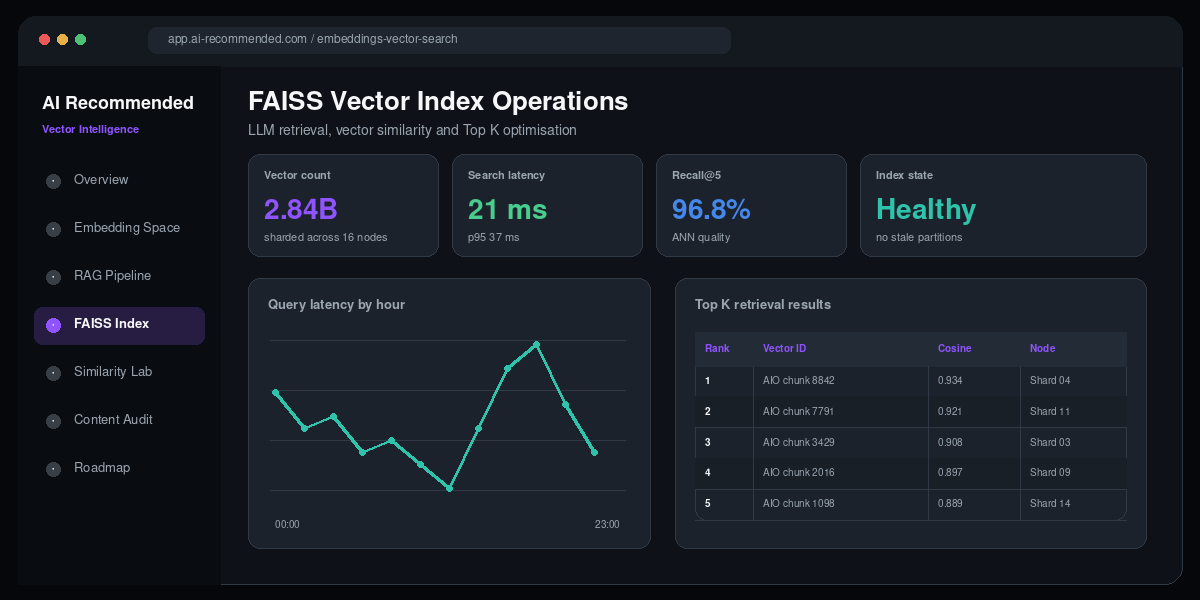
Content that was never crawled, chunked, and embedded is not inside the vector index. Its retrieval probability is therefore zero until the technical-access problem is fixed.
A dedicated explanation is available in What Is Vector Search and Why Does It Matter?.
What Does Cosine Similarity Measure?
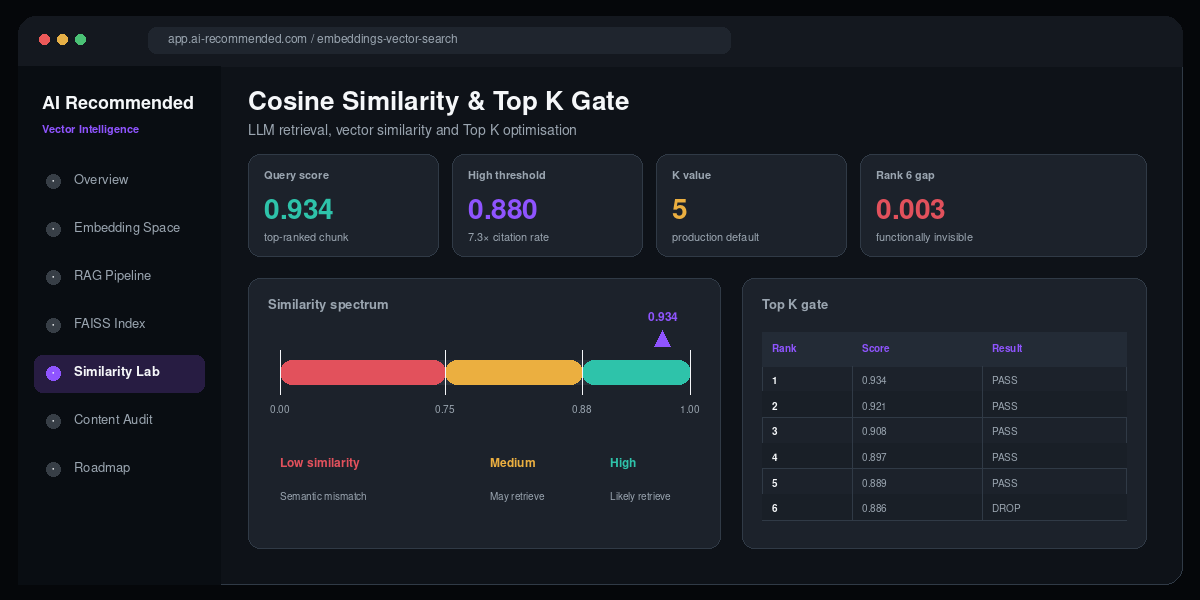
Direct answer: Cosine similarity measures the angle between the query vector and a content vector. A score close to one indicates that the two vectors point in a similar semantic direction. A lower score indicates weaker conceptual alignment, even when some words overlap. iPullRank’s cosine-similarity and k-nearest-neighbour guide shows how the same comparison can be applied to content analysis.
| Cosine Similarity Measures | Cosine Similarity Does Not Measure |
|---|---|
| Semantic alignment between the query and content | Factual accuracy — a wrong passage can still be semantically aligned |
| Conceptual proximity inside the same topic space | Source authority or brand trust during pure vector scoring |
| Vocabulary and entity overlap in context | Completeness, originality, or whether the answer is commercially useful |
| Relative direction of normalized text embeddings | Whether the content deserves final attribution after retrieval |
Why Is High Cosine Similarity Necessary but Not Sufficient?
Cosine scoring is effective at identifying broad topic alignment but can struggle with fine-grained intent, research agenda, factual quality, and unique usefulness. Semantic-search guidance from Neil Patel reinforces the distinction between matching words and understanding meaning. Two passages can point in nearly the same semantic direction while only one contains the exact evidence the LLM needs.
Semantic alignment earns entry into the candidate set. Distinctive information earns the citation after the candidate set reaches the synthesis stage.
Vector retrieval optimization principleRead How Semantic Similarity Affects AI Retrieval for a deeper explanation of broad semantic alignment and fine-grained relevance.
How Do Top-K Selection, Metadata Filters, and Reranking Change the Results?
Direct answer: Top-K selection limits how many passages leave the first search stage. Metadata filters decide which passages are eligible, and reranking applies a more expensive relevance model to reorder the candidates. Cohere’s rerank overview describes reranking as ordering a supplied document list from most to least relevant to the query, while OpenAI vector stores expose semantic-search infrastructure that returns a scored set of matching files or passages.
| Retrieval Control | What It Changes | LLM SEO Risk |
|---|---|---|
| Top-K candidate count | Controls how many first-stage matches remain available for reranking or generation. | A narrowly relevant passage can be functionally invisible when stronger or more generally aligned passages fill the available positions. |
| Similarity threshold | Rejects candidates whose score falls below a configured minimum. | Vague sections may fail the threshold even when the full page broadly discusses the subject. |
| Metadata filter | Restricts results by date, language, geography, permissions, content type, author, product, or other fields. | Missing or incorrect metadata can exclude a perfect passage before semantic scoring starts. |
| Diversity rule | Reduces near-duplicate results so the final context contains several perspectives or sources. | Multiple repetitive sections from the same site may compete with one another instead of expanding total coverage. |
| Cross-encoder reranker | Evaluates the query and each candidate together, allowing finer intent matching than independent embeddings alone. | A passage with broad vector similarity can fall when it does not answer the exact question or lacks the requested condition. |
| Context assembly | Trims, orders, deduplicates, or groups passages before they enter the model prompt. | Long introductions and repeated boilerplate can displace the decisive sentence or evidence from the final context window. |
Reranking is one reason a high cosine score should not be treated as the final success metric. Cohere’s reranking guidance shows that documents are compared against the query with a deeper model after retrieval. The winning passage therefore needs both broad semantic alignment and exact answer usefulness.
Why Do Many Systems Combine Vector Search With Keyword Search?
Direct answer: Hybrid retrieval combines semantic vector matching with lexical or full-text matching. Vector search is strong when the wording differs but the meaning is close. Keyword search is strong for exact names, error codes, model numbers, dates, quotations, legal clauses, and specialised terminology. Microsoft’s hybrid-search documentation explains how vector and full-text queries can run in parallel and be merged with Reciprocal Rank Fusion.
| Query Pattern | Vector Search Strength | Keyword Search Strength | Best Content Response |
|---|---|---|---|
| Conceptual question | Finds paraphrases, related explanations, and conceptually equivalent language. | Can identify exact category terms when the query is explicit. | Use a direct definition followed by natural synonyms, entities, and examples. |
| Product or model lookup | Can retrieve related product families and use cases. | Matches exact SKU, version, model, or feature names. | Preserve exact identifiers in headings, tables, specifications, and metadata. |
| Current policy or standard | Finds passages discussing the same requirement in different language. | Matches official names, section numbers, dates, and regulatory phrases. | State the official entity, version, jurisdiction, and effective date clearly. |
| Troubleshooting | Finds symptoms and conceptually related failure modes. | Matches exact error text, log tokens, commands, and status codes. | Include the literal error string and a plain-language explanation in the same section. |
| Brand comparison | Finds decision criteria and similar solution categories. | Ensures the named brands and product terms are present. | Name every compared entity and organise the answer by explicit buyer criteria. |
For LLM SEO, hybrid retrieval means exact language still matters. It simply matters alongside semantic meaning rather than instead of it. iPullRank’s work on fuzzy matching and semantic search, Semrush’s semantic-search overview, and Ahrefs’ semantic-search guide all support a balanced approach: preserve precise entities and terms while building complete contextual meaning.
How Do Chunking, Overlap, and Metadata Affect Retrieval?
Direct answer: Chunking determines the unit that receives an embedding and competes in search. Overlap determines how much context is repeated between neighbouring chunks. Metadata provides structured fields for filtering, grouping, freshness, source identity, and access control. A weak chunking strategy can separate a claim from its evidence, combine several intents into one vector, or create so much duplication that near-identical passages crowd the result set.
| Chunking Problem | What the Retrieved Passage Looks Like | Recommended Fix |
|---|---|---|
| Pronoun without subject | “It improves recall when configured correctly,” with no indication of what “it” refers to. | Restate the entity: “Hybrid retrieval improves recall when vector and lexical candidates are balanced correctly.” |
| Evidence separated from claim | The statistic is in one chunk and the source, conditions, or explanation is in another. | Keep the claim, source, scope, and interpretation in the same answer unit whenever possible. |
| Mixed intent | One section defines embeddings, compares databases, explains crawling, and sells a service. | Split by decision or question so each vector has one dominant semantic direction. |
| Boilerplate dominance | Navigation, repeated CTAs, disclaimers, or author text occupy a large share of the chunk. | Keep core answers structurally distinct and ensure extraction pipelines can identify the primary article body. |
| Missing freshness data | The answer is relevant but the system cannot tell whether it reflects the current product, policy, or standard. | Publish visible update dates, version references, and structured metadata, and refresh stale passages rather than only changing the page footer. |
The dedicated cluster articles What Are Embeddings in LLM SEO?, What Is Vector Search and Why Does It Matter?, How Semantic Similarity Affects AI Retrieval, and How to Write Content That Matches Vector Retrieval provide the supporting detail for each layer.
Which Eight Content Decisions Improve Vector Retrieval?
Use the vocabulary of the target query
Write headings and opening answers using the terminology buyers use in prompts. Semrush’s semantic-search guidance explains why meaning and intent matter beyond literal keyword overlap. Specific query language normally produces closer embedding alignment than polished but broader marketing synonyms.
Open every section with a BLUF answer
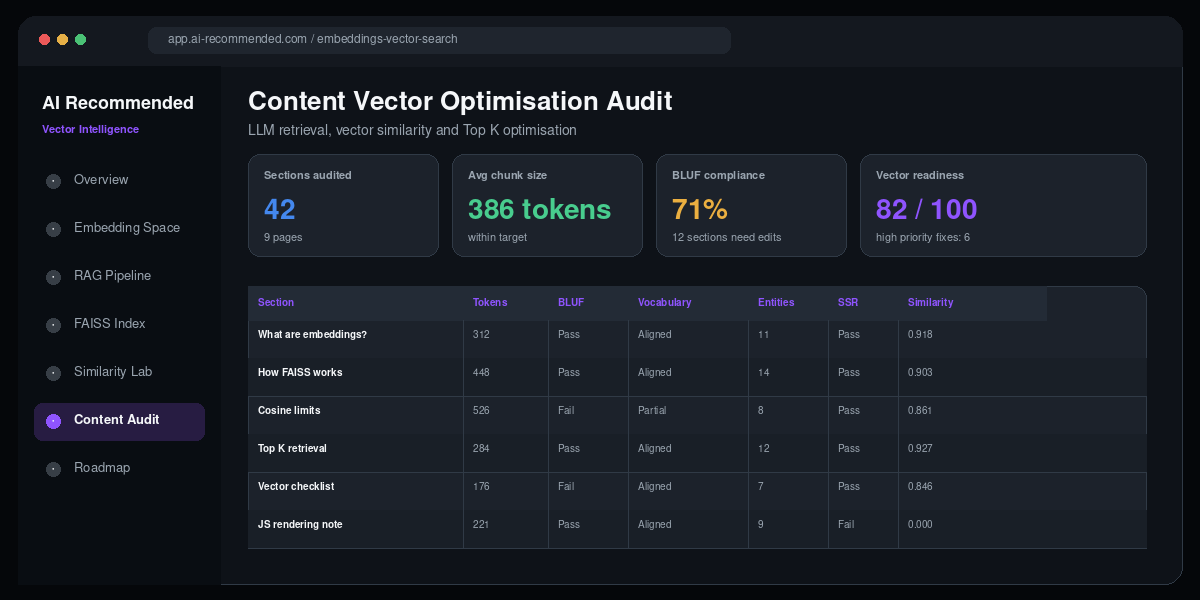
Answer the heading within the first 40–60 words. This establishes the section’s primary semantic context before examples and supporting material introduce secondary concepts.
Keep one H2 section focused on one intent
Target roughly 256–512 tokens, or approximately 180–380 words, when the topic permits. Split sections that move into a genuinely different question or decision. Ahrefs’ topic-first analysis is useful when deciding where one semantic subject ends and another begins.
Name specific entities
Use ChatGPT, Perplexity, FAISS, BERT, DPR, GPTBot, and named organisations rather than vague phrases such as “AI tools,” “search engines,” or “research shows.”
Serve priority content in visible HTML
Confirm every important heading and answer remains available when JavaScript is disabled. Google’s JavaScript SEO guidance explains the difference between initial HTML and rendered content. Content a retrieval crawler or ingestion process cannot access cannot be chunked, embedded, indexed, or retrieved.
Keep exact identifiers beside semantic explanations
Preserve model names, version numbers, standards, product codes, locations, dates, and error messages. Hybrid systems can use lexical matching for exact identifiers and vector similarity for the surrounding meaning.
Attach evidence to the claim it supports
Place the source name, statistic, date, scope, and interpretation near the claim. A self-contained chunk is more useful during retrieval and less likely to be quoted without its conditions or attribution.
Reduce duplicated answer blocks
Avoid publishing several nearly identical definitions across many pages. Consolidate the strongest explanation, then use descriptive internal links to connect supporting pages and preserve a clear pillar-and-cluster relationship.
For a practical writing workflow, read How to Write Content That Matches Vector Retrieval.
Vector Retrieval Optimization Checklist
| Area | What to Check | Pass Condition |
|---|---|---|
| Technical access | Priority pages are accessible to OpenAI’s crawlers, PerplexityBot, and ClaudeBot, with content visible in server-rendered HTML. | Server logs show successful responses and all important sections remain visible with JavaScript disabled. |
| Chunk structure | Each H2 addresses one specific query variant as an independent answer unit. | The section makes sense without reading the surrounding page. |
| Chunk size | Sections fall broadly within 256–512 tokens when the subject permits. | No short section leaves the answer incomplete and no oversized section mixes unrelated intents. |
| BLUF format | The first 40–60 words answer the heading before evidence and background. | The answer is present when only the opening paragraph is read. |
| Vocabulary alignment | Headings and opening sentences use the language buyers use in real AI prompts. | Target sub-queries and content terminology match without forcing awkward repetition. |
| Entity specificity | Specific platforms, tools, organisations, researchers, and metrics replace generic labels. | Every priority section contains the entities needed to disambiguate its exact subject. |
| Cosine plus distinctiveness | The section includes original data, a named-source statistic, or a uniquely useful explanation. | The chunk contributes something competitors do not provide after it passes similarity scoring. |
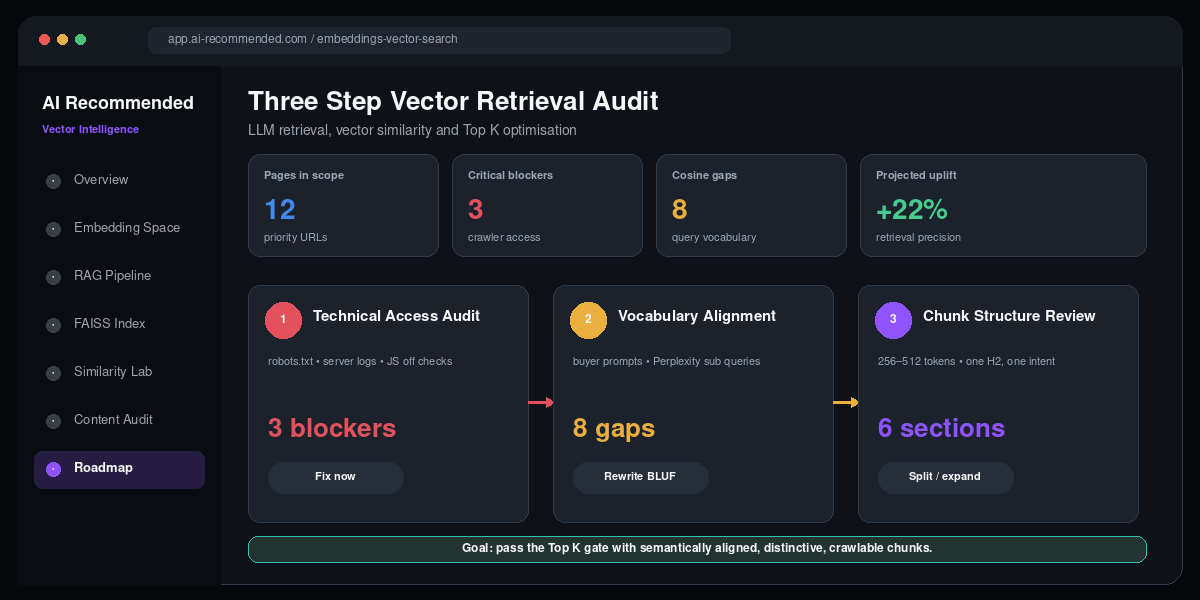
What Is the Three-Step Vector Retrieval Audit?
Technical access audit
Disable JavaScript and inspect every priority page. Review robots.txt, the official OpenAI crawler documentation, Perplexity crawler documentation, Claude crawler guidance, and server logs. Fix blocked, challenged, or incomplete responses before editing content.
Vocabulary alignment check
Run five to ten target buyer prompts in a platform that exposes intermediate searches. Record the generated sub-queries and compare them with the page headings and BLUF sentences.
Chunk-structure review
Flag sections below 100 words, above 400 words, or covering multiple intents. Split mixed sections, expand incomplete answers, and move the direct answer into the first 60 words.
How Should a Team Test Retrieval Before Publishing?
Direct answer: Test retrieval at the section level, not only by reading the page. Build a small prompt set, map each prompt to the passage that should answer it, run vector and hybrid searches, inspect the candidate list, and record whether the correct chunk survives filtering and reranking. A page can look excellent in a browser while the wrong section is being returned for the actual buyer question.
Create a judged prompt set
Collect real buyer questions across definitions, comparisons, technical requirements, objections, use cases, implementation, and measurement. For each question, identify the ideal page and the exact section that should be retrieved.
Inspect the indexed chunk
Confirm that the section heading, direct answer, evidence, URL, date, and metadata appear together after ingestion. Do not assume the index contains the same text hierarchy shown in the browser.
Compare vector, keyword, and hybrid retrieval
Run the same question through each method. Vector-only failure may reveal weak semantic focus; keyword-only failure may reveal missing exact terms; hybrid failure may reveal a broader indexing or relevance problem.
Review the complete candidate list
Record the target chunk’s rank, score, competing passages, source diversity, and whether duplicates occupy several positions. The most useful optimisation insight often comes from the passages that outrank the intended answer.
Test exact conditions and edge cases
Add prompts containing product versions, locations, dates, audiences, exclusions, and negative requirements. These tests reveal whether metadata, lexical matching, and reranking preserve the precise intent rather than only the broad topic.
Re-test after every structural edit
Changes to headings, chunk length, internal navigation, boilerplate, page templates, JavaScript rendering, or metadata can alter retrieval. Maintain a fixed regression set so improvements to one query do not silently damage another.
The correct question is not “Does this page mention the topic?” It is “Does the intended passage enter the candidate set for the exact prompt, and does it remain the strongest answer after filters, deduplication, and reranking?”
Retrieval testing principleFor broader AI-search measurement, connect retrieval diagnostics with the LLM Optimization pillar and the Semantic SEO for LLMs cluster. Retrieval explains whether the content becomes available; visibility tracking explains whether the final system actually cites, mentions, or recommends the brand.
How Should Vector Retrieval Performance Be Measured?
Frequently Asked Questions
What is a vector embedding in LLM retrieval?
What is FAISS and why does it matter for LLM SEO?
Does domain authority affect cosine similarity?
What chunk size is best for LLM retrieval?
Why can rank six be functionally invisible?
How can content improve cosine similarity?
Is vector search always better than keyword search?
What is the difference between retrieval and reranking?
Can metadata prevent a relevant passage from appearing?
Key Takeaways
- LLM retrieval converts content and queries into numerical vectors and compares their semantic direction.
- FAISS and comparable indexes make approximate nearest-neighbour search practical at production scale.
- The Top-K boundary is a hard functional gate; content outside it does not reach synthesis.
- Cosine similarity measures semantic alignment, not factual accuracy, authority, completeness, or originality.
- Use target-query vocabulary, BLUF openings, focused 256–512 token sections, named entities, and visible HTML.
- High similarity can earn first-stage retrieval; exact intent fit, evidence, filters, diversity rules, and reranking determine whether the passage survives.
- Hybrid retrieval preserves the value of exact entities, codes, dates, and specialised terms while vector search covers paraphrases and conceptual similarity.
- Audit technical access, chunk boundaries, metadata, candidate rank, and reranking before rewriting content because each layer can independently block retrieval.

About the Author
Marcus Hibbert is the founder of AI Recommended, a leading Generative Engine Optimisation (GEO) agency helping UK B2B technology companies become the trusted recommendation across ChatGPT, Google AI Mode, AI Overviews, Gemini, Claude, Perplexity and Microsoft Copilot whenever decision-makers search for products, services and solutions.
Connect with Marcus on LinkedIn
Request an LLMO Audit
Discover how AI platforms describe, cite and recommend your brand across the prompts your ideal buyers use—and uncover opportunities to become AI's trusted recommendation.
By submitting this form, you’re requesting a Large Language Model Optimization (LLMO) audit for your brand.

.png)